
Broncos - King Laugh
There is a moment in Bram Stoker's Dracula when Professor Van Helsing, preparing for the burial of Lucy Westenra, begins talking about what he calls “King Laugh.” In the middle of death and unbearable grief, laughter can arrive without invitation, not because the situation has suddenly become less terrible but because human beings somehow continue to find life inside circumstances that should logically extinguish it.
For Broncos, that strange contradiction provides both the title and the emotional centre of their debut album.
Released on September 10, 2026, King Laugh finds the Belfast trio of Shane McMullan on bass and lead vocals, Cameron Leggat on guitar and backing vocals and Michael Smyth on drums transforming two years of concerts, rehearsals, travelling and accumulated emotional debris into an album built around opposing forces. Relationships begin while already carrying the possibility of their own destruction. Grief exists alongside euphoric choruses. Aggressive riffs collide with soaring melodies, while moments of atmospheric calm frequently exist only a few seconds away from another eruption.
Broncos have always operated somewhere within the broad territory of post-hardcore, but King Laugh demonstrates how inadequate that description becomes when treated too rigidly. There is certainly enough aggression here to justify it, alongside the reckless momentum associated with bands such as At The Drive-In, the melodic scale of Alexisonfire and the enormous guitar weight that inevitably brings Deftones into the conversation. Yet Broncos are increasingly interested in what happens between those reference points rather than simply reproducing them.
The band's origins partly explain that approach. Broncos emerged from the remains of other projects involving Smyth and Leggat, but it was the arrival of McMullan that finally gave the group its definitive shape. Rather than establishing a list of genre conventions that Broncos should follow, the three musicians appear to have concentrated on the individual qualities they admired in other bands: intensity, melody, rhythmic complexity, atmosphere and the ability to make heavy music feel emotionally vulnerable.
That distinction becomes increasingly important across King Laugh.
Broncos are undoubtedly capable of making extremely heavy music, but heaviness is rarely the destination. Their best moments depend upon contrast. McMullan's cleaner, frequently soaring voice can exist against Leggat's considerably more abrasive backing vocals, while the guitar can move between atmospheric delay and riffs designed to produce an immediate physical response. Smyth's drumming provides another crucial part of that identity, moving from intricate rhythmic details towards enormous kick, snare and tom patterns without allowing the music to lose momentum.
The album begins by treating anticipation itself as an instrument.
At just under two minutes, “To The Grave” functions almost like the opening curtain. Ominous synthesizers create an uncomfortable atmosphere before something darker begins to emerge underneath them. The initial restraint gradually disappears as cymbals and sharp guitar attacks enter, providing a concise introduction to the dynamic language that Broncos will spend the remainder of the album expanding.
It is significant that the band chose to develop the track until it reflected the way they actually perform it live. King Laugh may possess a broader and more polished production than Broncos' earliest recordings, but the album rarely attempts to conceal the fact that this is fundamentally a live band.
That becomes immediately apparent on “Lover.”
Originally released in 2025, the song condenses much of Broncos' identity into less than three minutes. Screamed backing vocals collide with McMullan's more melodic delivery, while the rhythm section drives towards a chorus that seems constructed with the expectation that eventually an entire room will be shouting it back at the stage.
Yet beneath that physicality is something considerably less certain.
Lover explores the uncomfortable ambiguity of a relationship in which desire for something deeper exists alongside the instinct to protect yourself from the heartbreak that deeper involvement might eventually create. The music therefore reproduces the emotional contradiction of the lyrics. Aggression and vulnerability do not occupy separate sections of the song; they exist simultaneously.
“Hold Me” pushes that relationship between rhythm and melody even further. After a brief chiming introduction, Smyth's snare effectively launches the song forward, while Leggat's guitar lines twist around McMullan's bass. The dual vocals become particularly effective during the pre-chorus, where the repeated idea that old habits leave scars transforms something personal into something designed for collective release.
This is one of the interesting characteristics of Broncos. Their lyrics frequently deal with experiences that are private, uncomfortable or painful, but the music continually converts them into something communal.
A difficult memory becomes a chorus.
Grief becomes something hundreds of people can shout together.
That transformation is particularly powerful on “In Amber,” the oldest composition on the album. Originally written by Smyth for an earlier project, the song eventually found the environment it required within Broncos. Reverb and texture initially create space around the instruments before the central riff arrives with a much more awkward, lurching weight. Guitar and drums lock together rhythmically while the bass provides a more melodic movement underneath them.
When the chorus opens, the proportions change completely.
What had felt tense and constricted suddenly becomes enormous and almost euphoric, yet the subject is the loss of somebody close and the hollow absence left behind afterwards. McMullan and Leggat's different vocal approaches allow the same grief to appear from more than one emotional perspective.
That ability to find euphoria inside painful material lies very close to the meaning of King Laugh itself.
The album's middle section refuses to remain contemplative for long. “Immaculate” and “So Wrong” arrive with the unstable momentum of early-2000s post-hardcore, pushing the tempos considerably higher and allowing Broncos to sound as though the songs might escape from their control at any moment.
Immaculate is particularly revealing because its working title was apparently “Beastie Boys,” a reference to the more groove-oriented quality of its verses. That small detail says quite a lot about Broncos' attitude towards post-hardcore. They are not particularly interested in protecting the purity of the genre. Groove, melodic hooks, atmospheric textures and brute force can all occupy the same record provided they contribute something useful.
“Saline” demonstrates the benefits of that openness particularly well because it grew from an accidental moment during rehearsal. McMullan began playing the harmonics that eventually became the song's introduction, Smyth responded with a drum-and-bass-inspired rhythm and the idea gradually expanded into something considerably larger. During recording, all three members contributed additional guitar ideas, with one layer suggesting another until the track became one of the album's most texturally ambitious moments.
There is something important about a song emerging in that way on an album recorded and mixed by the band themselves.
Rather than entering a commercial studio with a clock running and a predetermined collection of finished arrangements, Broncos transformed their practice space into their own recording environment. That gave them time to experiment with synthesizers, guitar layers and production ideas without removing the instinctive qualities developed through years of playing together.
The DIY aspect of King Laugh therefore goes considerably deeper than questions of budget or independence.
It affects the sound of the record.
Broncos were able to discover arrangements rather than simply document them, which explains why the album can feel more expansive than their live performances without becoming disconnected from them. Synthesizers and additional guitar textures enlarge the environment, but underneath them remain three musicians playing with the urgency of a band accustomed to hot rooms, loud amplifiers and audiences standing only a few feet away.
“Mistakes of the Past” provides another connection to the group's prehistory. Written by Leggat for an earlier project, it was one of the pieces he and Smyth refused to abandon when Broncos began taking shape. The reason is immediately understandable. Its opening guitar announces something much more physical, while bass and drum accents repeatedly increase the tension before the entire band breaks forward.
Again, the dual-vocal approach becomes essential.
One voice can carry aggression while another preserves melody, preventing the song from having to choose between the two. A later half-time section gives Leggat space to push his delay into self-oscillation, allowing spiralling noise to accumulate before the final return of the chorus.
And then comes “Gloom.”
Already established as a live favourite before the album's release, Gloom reveals perhaps more clearly than any other song how much Broncos have developed their understanding of patience.
Dreamlike synthesizers initially create an unexpectedly spacious atmosphere before guitars gradually reveal the shape of the song. Bass and vocals enter without hurry, followed by drums that initially contribute only enough kick and snare to increase the pressure. Nothing is rushed because Broncos understand that the eventual impact depends upon how long they are prepared to delay it.
When the full band finally arrives, the weight feels enormous.
The central riff is crushing but remains melodic, repeatedly interrupted by suspended spaces that make its return feel even heavier. As the song develops, Leggat's guitar begins climbing, McMullan's bass introduces another layer of melodic tension and Smyth uses increasingly detailed cymbal patterns before the rhythm section tightens everything towards another release.
The lyrics make that gradual construction particularly appropriate.
Gloom concerns the decision to enter a relationship while already understanding that it is probably doomed. Desire and lucidity therefore exist simultaneously. Nobody involved is entirely deceived, yet knowing how something will end does not necessarily remove the desire to experience it.
This is King Laugh in miniature.
The end is visible.
Life continues anyway.
The album's closing “A Song Under the Sun” takes that philosophy towards one final eruption. A choir of voices and distant percussion initially create an almost deceptive calm before Leggat's guitar and Smyth's drums break through it. The song repeatedly expands and contracts, opening into broad melodic spaces before another rhythmic assault destabilises them.
Even here, Broncos resist simply making everything louder until the record stops. The arrangement withdraws at crucial moments, giving the listener enough room to recover before another wave arrives.
That understanding of space before impact may be one of the most important developments on King Laugh.
A younger version of the band might conceivably have relied almost entirely upon the force of its riffs and performances. The Broncos heard here have begun understanding that heaviness is relational. A guitar sounds larger when something quieter existed immediately before it. A screamed vocal becomes more effective beside a clean one. A euphoric chorus can become devastating when the subject underneath it is grief.
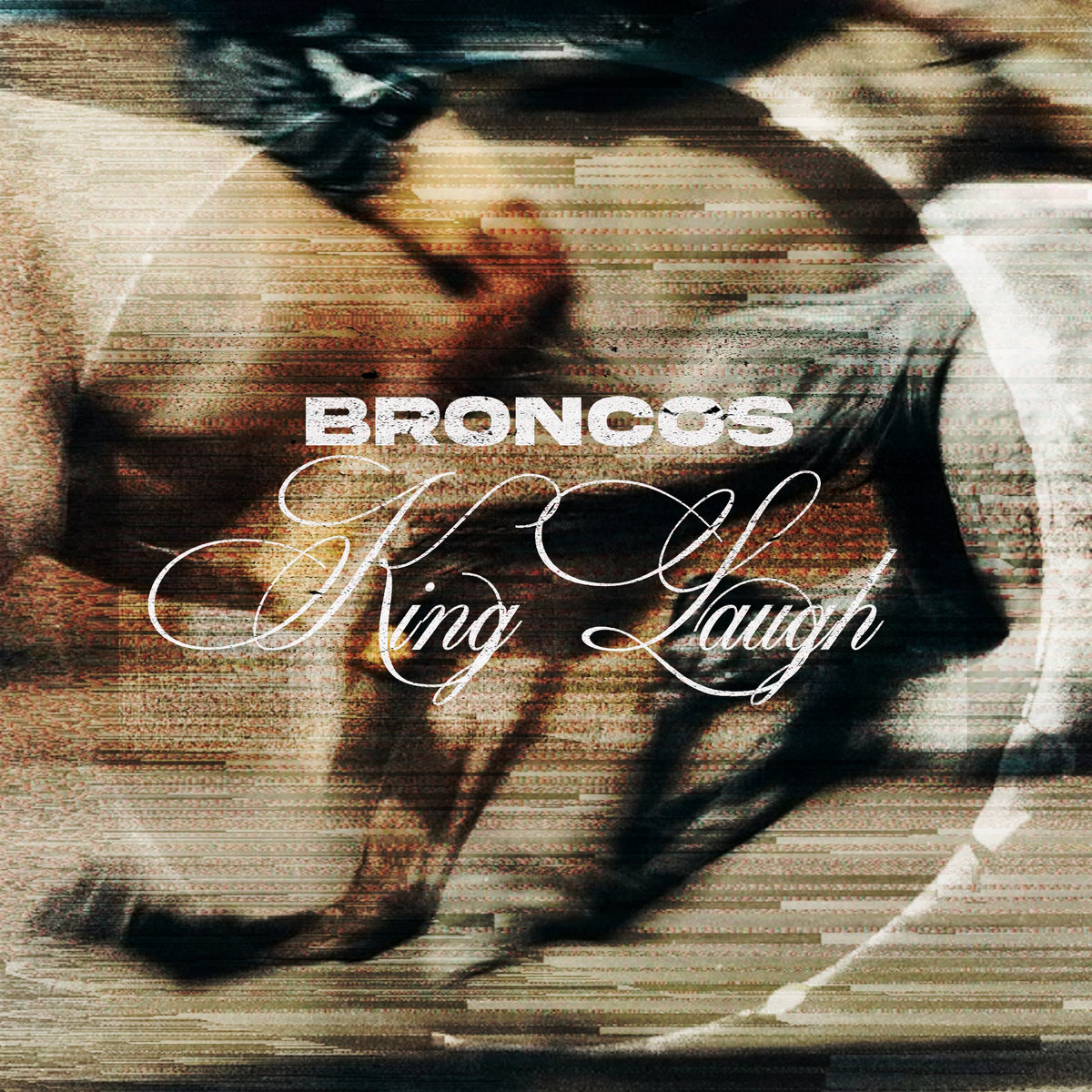
Even the album artwork, created by Smyth, plays with similar contradictions. Equestrian imagery inevitably acknowledges the band's name, but the distorted sense of motion suggests something considerably less playful: movement accelerating towards an uncertain endpoint, with the idea of a burial ring capturing the last traces of light before darkness takes over.
And yet King Laugh never feels nihilistic.
That is where the reference to Dracula becomes essential. Van Helsing's King Laugh is not denial. He does not erase death, grief or fear. He simply represents the strange capacity of human beings to discover another impulse existing beside them.
Broncos spend much of their debut album exploring exactly that space.
Relationships collapse, people disappear, old mistakes continue leaving scars and desire leads willingly towards situations that already contain the possibility of pain. The music does not attempt to solve those experiences. Instead, it converts them into movement, volume, melody and collective release.
That is why the band's reputation as a live act matters so much to understanding this album.
The years preceding King Laugh involved hundreds of hours in rehearsal rooms, long journeys in vans, uncomfortable hostels, tinnitus-inducing performances and the gradual camaraderie produced by repeatedly experiencing those things together. Their acclaimed appearances at events including Output 2025 and Sweet Sweet Noise helped establish Broncos as one of the more compelling emerging bands from Belfast's alternative scene, while singles such as Lover and Hold Me attracted attention from outlets including BBC Introducing and RTÉ2XM.
But the significance of King Laugh is not simply that Broncos have finally collected those songs onto an album.
It is that they have begun to understand what makes them sound like Broncos.
The traces of At The Drive-In, Alexisonfire, Deftones and early-2000s post-hardcore remain easy enough to identify, but increasingly they function as pieces of vocabulary rather than instructions. The rhythmic imagination of Smyth, Leggat's movement between riffs and atmosphere, McMullan's melodic bass and the constant interaction between clean and aggressive vocals give the band an identity that becomes clearer as the record progresses.
Synthesizers and more ambitious studio production expand that identity without sanitising it.
This is still music that seems designed to leave a room sweating.
Yet beneath the physical intensity lies an album unusually preoccupied with resilience. King Laugh repeatedly acknowledges that endings are unavoidable without accepting that they make everything preceding them meaningless. Love can be worthwhile even when it collapses. Grief exists because something mattered. Old songs can survive the death of previous bands and eventually find new lives inside another one.
Even Broncos themselves were assembled partly from the remains of projects that had disappeared or never properly begun.
Perhaps that makes the title more appropriate still.
King Laugh is filled with the death of things, but almost every ending creates something else. A lost relationship becomes a song. An abandoned composition finds a new band. A rehearsal-room accident becomes Saline. Years of exhausting live performances become the foundation of a debut album.
For Broncos, resilience does not mean pretending that darkness is temporary or easily defeated.
It means making enough noise inside it to prove that you are still there.
© Thusblog
Listen on Qobuz Hi-res (24-bit)