

Hallan - Solomon
In an age when opinions are formed almost as quickly as headlines appear, the distinction between knowledge and conviction has become increasingly difficult to maintain. Hallan, the Portsmouth-based post-punk quartet, confront that uncomfortable reality on “Solomon,” a sharp, abrasive single that draws upon biblical history to question how contemporary society understands truth, authority and the consequences of reacting before thinking.
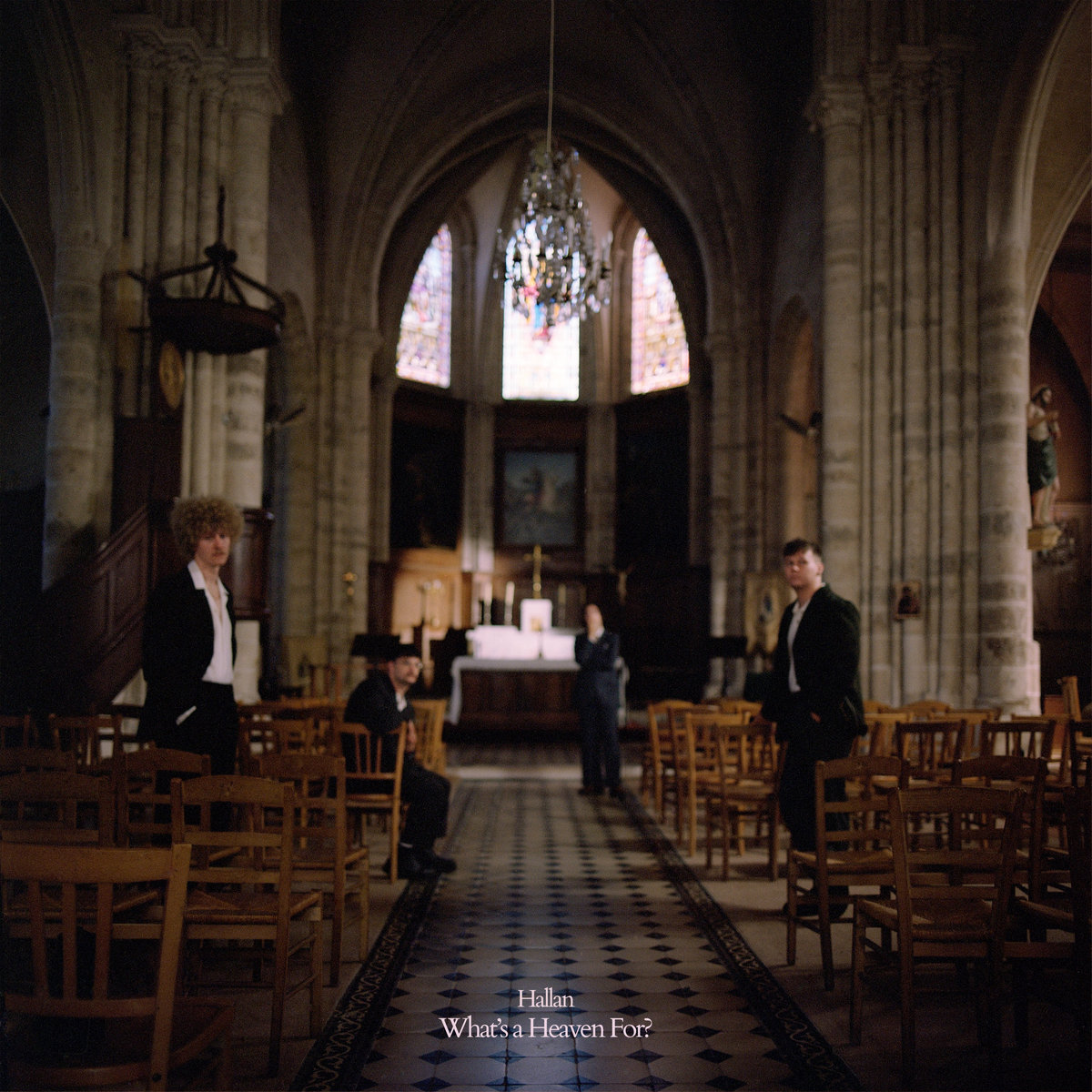
The track introduces the band's forthcoming debut album, What's a Heaven For?, scheduled for release on January 29, 2027, through their own imprint, Mystery of Things. It is a compelling introduction to a record that promises to continue Hallan's interest in combining angular guitar music with social observation, historical references and a distinctly theatrical approach to storytelling.
Emerging from Portsmouth, England, Hallan have developed a musical identity rooted in post-punk and alternative rock, with an emphasis on restless rhythms, abrasive guitar arrangements and lyrics that examine the contradictions of modern life. Their music draws upon the urgency of British post-punk while allowing room for irony, narrative experimentation and an occasionally surreal perspective on everyday experiences.
“Solomon” places those qualities firmly in the foreground.
Gritty basslines establish the track's momentum, while shimmering guitar passages introduce a contrasting sense of space and movement. The drums maintain a compressed, forceful rhythm, giving the arrangement a nervous energy that suits the uncertainty explored in the lyrics.
Rather than relying upon sheer volume, Hallan create tension through the interaction between these elements. The bass provides a persistent sense of urgency, the guitars alternate between brightness and abrasion, and the percussion pushes everything forward with little opportunity for reflection.
Above this restless instrumental foundation, frontman Conor Clements introduces the historical and biblical figure of King Solomon, traditionally associated with wisdom, judgement and the ability to distinguish truth from competing claims.
It is a particularly effective reference for a song concerned with the contemporary information landscape.
In an environment dominated by instant reactions, conflicting narratives and the constant circulation of news, the patience required to understand complicated situations can easily disappear. Hallan use Solomon's symbolic association with wisdom to question whether modern society still values careful judgement or has become more interested in the immediate satisfaction of certainty.
The contrast between ancient history and contemporary behaviour gives the song an interesting conceptual foundation. Although the technologies through which information circulates have changed dramatically, the human desire to possess the truth, defend a position and pass judgement remains remarkably familiar.
Musically, the arrangement reinforces that conflict. The song's restless momentum suggests the pressure to respond immediately, while its sharper instrumental textures introduce a sense of unease beneath the energy.
Hallan have always seemed particularly interested in the possibilities of post-punk as a vehicle for storytelling, and Solomon demonstrates why the genre remains so effective for this kind of subject. Its rhythmic insistence and angular guitars allow the music to sound confrontational without requiring the lyrics to become a conventional political statement.
The accompanying video develops the song's ideas through an imaginative combination of history, everyday life and understated humour.
Filmed in Portsmouth and the surrounding area, including locations connected with the band's earlier history, the production embraces the practical limitations of independent filmmaking rather than attempting to disguise them behind an elaborate historical reconstruction.
The concept also draws upon an important aspect of Hallan's lives: the musicians work as teachers alongside their musical activities.
This relationship between education and artistic expression becomes central to the video's narrative. Clements appears as a teacher who develops an increasing fascination with the complicated history of Solomon, gradually allowing that interest to influence his perception of the world around him.
A mysterious knight begins appearing in everyday situations, creating a visual connection between historical imagination and contemporary reality. As the character's fascination develops into obsession, the boundaries between the two worlds become increasingly uncertain.
Yet the video is not simply concerned with intellectual fixation. It also explores the possibility of escaping ordinary expectations through movement, performance and imagination.
Clements gradually finds opportunities to dance and express himself more freely, briefly stepping into the role of a historical figure as the narrative allows past and present to overlap.
There is something particularly appropriate about this approach. A song concerned with how people interpret history and construct ideas about truth is accompanied by a video in which historical imagery literally intrudes upon everyday life.
The result gives Solomon an additional layer of meaning without requiring an expensive production or a straightforward illustration of its lyrics.
It also reflects an appealing contradiction within Hallan's identity. As teachers, the musicians participate in the transmission of knowledge and the interpretation of information. As artists, they are free to question established narratives, exaggerate situations and explore ideas through ambiguity rather than definitive answers.
Those two activities are not necessarily opposed. Both involve curiosity, interpretation and the challenge of encouraging people to look beyond their immediate assumptions.
That relationship gives the video a personal dimension which distinguishes it from a conventional promotional accompaniment. The band's professional lives become part of the creative concept, suggesting that their interest in history and social behaviour extends beyond the confines of songwriting.
With What's a Heaven For? approaching, Solomon also provides an indication of the territory Hallan intend to explore on their debut album. The combination of abrasive post-punk, historical imagery and contemporary social questions suggests a group interested in creating music that provokes thought without sacrificing immediacy.
There is a theatrical quality to the presentation, but the underlying questions remain recognisable. How do we decide what is true? Why are we so quick to react? And what might happen if we approached the flood of modern information with a little more patience and curiosity?
“Solomon” does not pretend to resolve those questions. Instead, Hallan turn them into a restless piece of guitar music, allowing the tension between knowledge and reaction to emerge through both the lyrics and the arrangement.
The accompanying video expands that idea with humour and imagination, finding a surprisingly natural connection between ancient history, the classroom and the everyday streets of Portsmouth.
As the first introduction to What's a Heaven For?, the single establishes an intriguing direction for the quartet. Hallan combine the nervous energy of post-punk with a fascination for history and the absurdities of contemporary behaviour, producing a song that feels both intellectually curious and immediately physical.
In a world increasingly impatient for answers, Solomon suggests that the more interesting questions may be the ones we have stopped taking the time to ask.
© Thusblog