
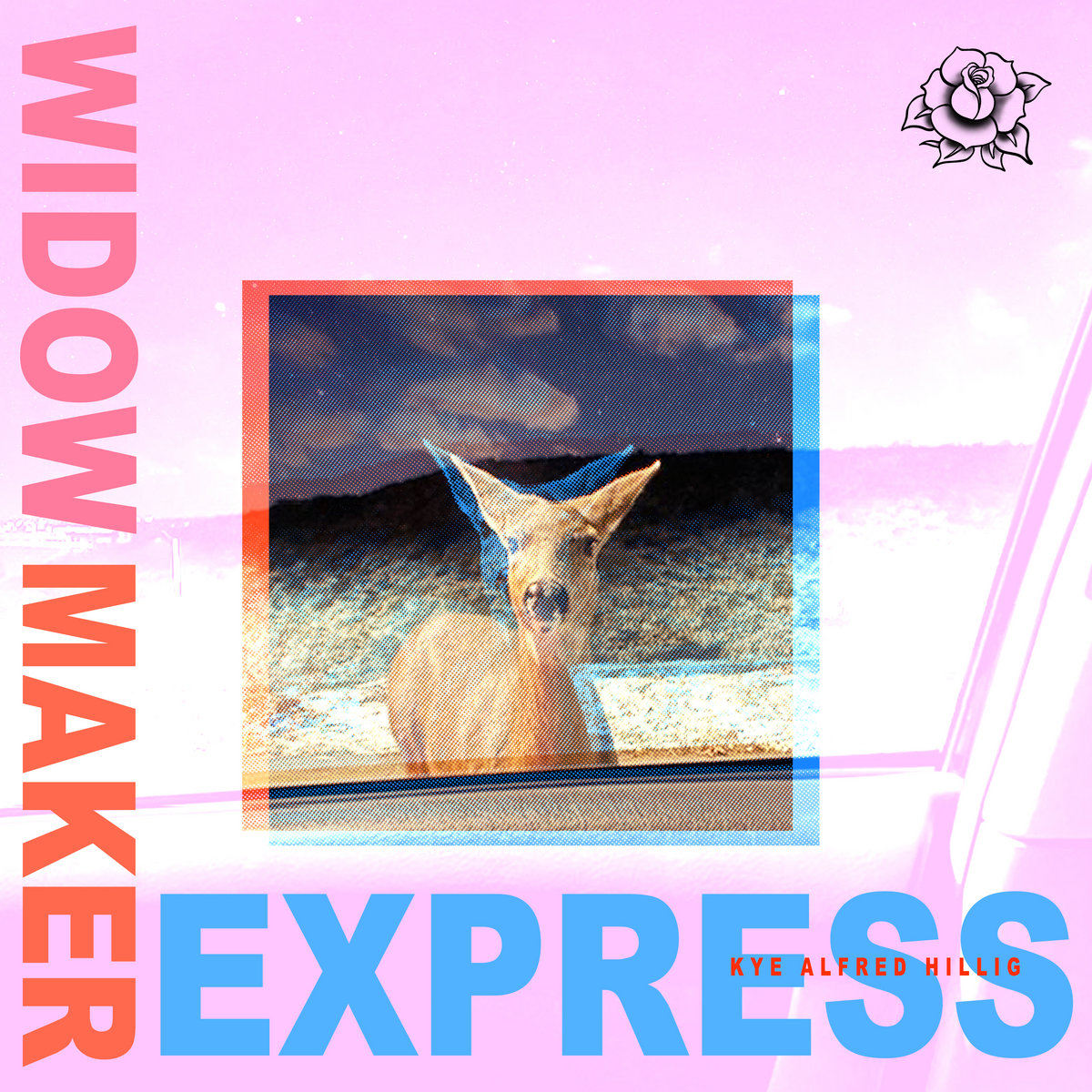
Kye Alfred Hillig – Widowmaker Express
Released: August 5, 2026
Genres: Folk / Singer-songwriter / Folk-rock / Alt-country
Some records are born from the simple desire to write songs. Others seem to appear because certain things have become impossible to carry without turning them into music. Widowmaker Express, the tenth solo album from Tacoma songwriter Kye Alfred Hillig, clearly belongs to the latter category.
Released on August 5, 2026, the album finds Hillig confronting many of the subjects that have long haunted his writing: absence, faith, love, mortality, grief, and that stubborn, sometimes inexplicable instinct that keeps us moving forward even when the reasons for doing so have become difficult to locate.
With Hillig, these questions rarely arrive as grand declarations. They inhabit quieter spaces instead: empty rooms, half-lit bars, wet roads, dark water and grey afternoons beneath the heavy skies of the Pacific Northwest. Widowmaker Express feels inseparable from that environment. Tacoma may not necessarily be named throughout the record, but its atmosphere seems embedded in the songs: industrial waterfronts, rusting metal, cold air coming off the water, distant trains and houses illuminated long before evening has properly arrived.
That emotional geography matters because Hillig has always written songs in which landscape and inner life gradually become difficult to separate.
Before establishing himself as a solo artist, he served as the principal songwriter for Destruction Island and Pistol For A Paycheck, experiences that helped shape an approach to songwriting with little interest in unnecessary ornamentation. Across more than a decade of solo work, Hillig has continued to explore a version of American songwriting stripped of romantic mythology.
His music may draw from folk, alt-country and independent rock, but genre has never really been the centre of what he does. The real focus is storytelling, language and the ability of a melody to turn private uncertainty into something recognisable to somebody else.
On Widowmaker Express, however, that writing takes on an especially personal weight.
The album emerged partly from a medical scare that ultimately proved to be a false alarm. The immediate danger may have passed, but the psychological consequences were harder to dismiss. Once the body has briefly suggested that the entire arrangement might suddenly end, returning to everyday life does not necessarily restore every previous certainty.
In many ways, that is where Widowmaker Express truly begins.
What do we do with time once we understand that none of it is guaranteed?
What happens to religious, emotional or philosophical certainties when mortality stops being an abstract concept?
And how do we continue loving people when everything we love already contains the possibility of losing it?
Hillig does not really attempt to answer those questions.
Instead, he turns them over repeatedly, examining them from different directions and occasionally allowing them to remain unresolved. The record becomes something resembling a difficult conversation between one person, the universe and a God whose presence sometimes feels almost as uncertain as the answers being requested.
That tension gives Widowmaker Express much of its remarkable cohesion.
Longtime friend and collaborator Daniel G. Harmann handles the production, resisting any temptation to reduce these songs to simple voice-and-guitar performances. His arrangements widen the emotional space around Hillig without overwhelming the intimacy at their centre. Piano, strings, lap steel and spectral textures drift through the record with considerable restraint.
The result is cinematic without becoming theatrical.
More importantly, Harmann understands that Hillig's songs need space.
Individual notes are sometimes allowed to hang in the air before the music dares to move forward. A guitar may appear somewhere at the edge of the mix and disappear just as quickly. Piano phrases emerge beneath particular lines without attempting to dictate how the listener should feel.
The arrangements function less as decoration than as architecture, creating spaces large enough for the songs to inhabit.
At times, Widowmaker Express almost feels like haunted folk music.
Not in any traditional gothic sense, but because so many of these songs seem shaped by the presence of things that are no longer there.
Opening track “Oh, Magic” establishes that feeling immediately. Absence becomes almost as tangible as presence, and Hillig never attempts to exaggerate the sadness. He simply allows it to exist. That restraint makes the emotional impact considerably stronger.
The same approach runs through much of the album.
“Disease of the Heart” examines a wound that reaches beyond conventional heartbreak. In Hillig's writing, the heart becomes both an emotional organ and a place where spiritual uncertainty gathers. The song moves through grief, exhaustion and the erosion of confidence in explanations that may once have seemed sufficient.
Faith occupies a particularly strange position throughout Widowmaker Express.
It is neither completely abandoned nor comfortably restored. Hillig seems more interested in what happens when someone continues speaking to God while becoming increasingly uncertain that anyone is listening.
That ambiguity gives the record much of its depth.
On “Coyote Skins”, loss takes another form. Rather than concentrating entirely on disappearance, the song considers what comes afterwards: the necessity of changing, shedding an old version of yourself and continuing despite knowing that you will never return completely to the person you were before.
Transformation in Hillig's world is rarely dramatic.
It is closer to adaptation.
You learn how to live with scars.
You rearrange the house around the missing rooms.
Eventually, you realise that another version of yourself has been taking shape while your attention was elsewhere.
“The Ghost Will Turn Around” provides one of the moments where resignation begins to develop into resistance. The ghosts remain, but Hillig refuses to surrender the entire present to them. Hope appears here cautiously, almost suspicious of itself, and it is precisely that uncertainty that makes it convincing.
Throughout the record, Hillig carefully avoids easy consolation.
That is particularly evident on “Indryd James”, one of the album's most affecting moments. Memory and loss are approached with extraordinary restraint. Nothing in the arrangement attempts to manufacture emotion. Instead, the song accepts a much more difficult truth: some absences never completely close.
You do not necessarily move beyond them.
You simply learn how to keep moving while carrying them.
That quality helps explain Hillig's distinctive place among songwriters from the Pacific Northwest. His work may occasionally pass through familiar Americana territory, but these songs are too uneasy, too philosophical and sometimes too strange to settle comfortably inside the genre.
Bars and highways are not aesthetic props in Hillig's writing.
They are places where people go to try to understand why they are still here.
Even the album title captures that sensation beautifully.
Widowmaker Express suggests a train already moving along tracks nobody aboard can truly control. We climb on without knowing exactly how long the journey lasts or where it will finally stop. Some passengers leave before us. Others appear unexpectedly along the route.
Meanwhile, the landscape keeps moving past the windows.
Mortality therefore becomes less a destination than a permanent travelling companion.
Yet despite the ghosts, losses and spiritual uncertainty scattered throughout the album, Widowmaker Express is not a nihilistic record.
Its deeper movement is actually towards rediscovering a reason to remain open to the world.
That idea reaches its fullest expression in closing track and lead single “On Small Wings.”
After spending much of the album questioning death, religion, separation and the occasionally absurd machinery of fate, Hillig ends with something considerably simpler: the possibility of love.
Not love as a universal solution.
Not love as a reward.
Instead, love appears as an unpredictable event for which we must somehow continue leaving space.
The song is built around patience and vulnerability, around the difficult discipline of refusing to close the door entirely even after learning everything that might enter alongside the light.
Within the context of the album, the effect is powerful.
Hillig does not pretend to have won his argument with the universe.
He simply decides that the absence of an answer does not prevent him from continuing.
That may ultimately be where Widowmaker Express finds its greatest strength.
Ten solo albums into his career, Kye Alfred Hillig could easily have begun repeating familiar gestures. Instead, this record appears to gather several different strands of his songwriting and give them greater emotional and musical scale.
The songs remain intimate, but Daniel G. Harmann's production creates enough space around them that they sometimes seem to extend far beyond the rooms in which they were recorded.
Folk, independent rock and alt-country blend together without becoming particularly visible labels.
What remains at the centre is a voice.
A voice capable of staring at mortality without romanticising it, questioning God without quite managing to abandon the conversation, remembering the dead and still searching for something resembling grace.
Widowmaker Express is therefore less an album about death than an album about what awareness of death does to the way we live.
It is about the reasons we invent for staying.
The ghosts we carry.
The people we continue loving even after they are gone.
And the ultimately radical possibility that after every loss, every fear and every unanswered question, love might still remain worth betting on.
Somewhere in the Tacoma fog, the train keeps moving.
So does Kye Alfred Hillig.
© Thusblog
Listen on Qobuz (Hi-res 24 bit)