
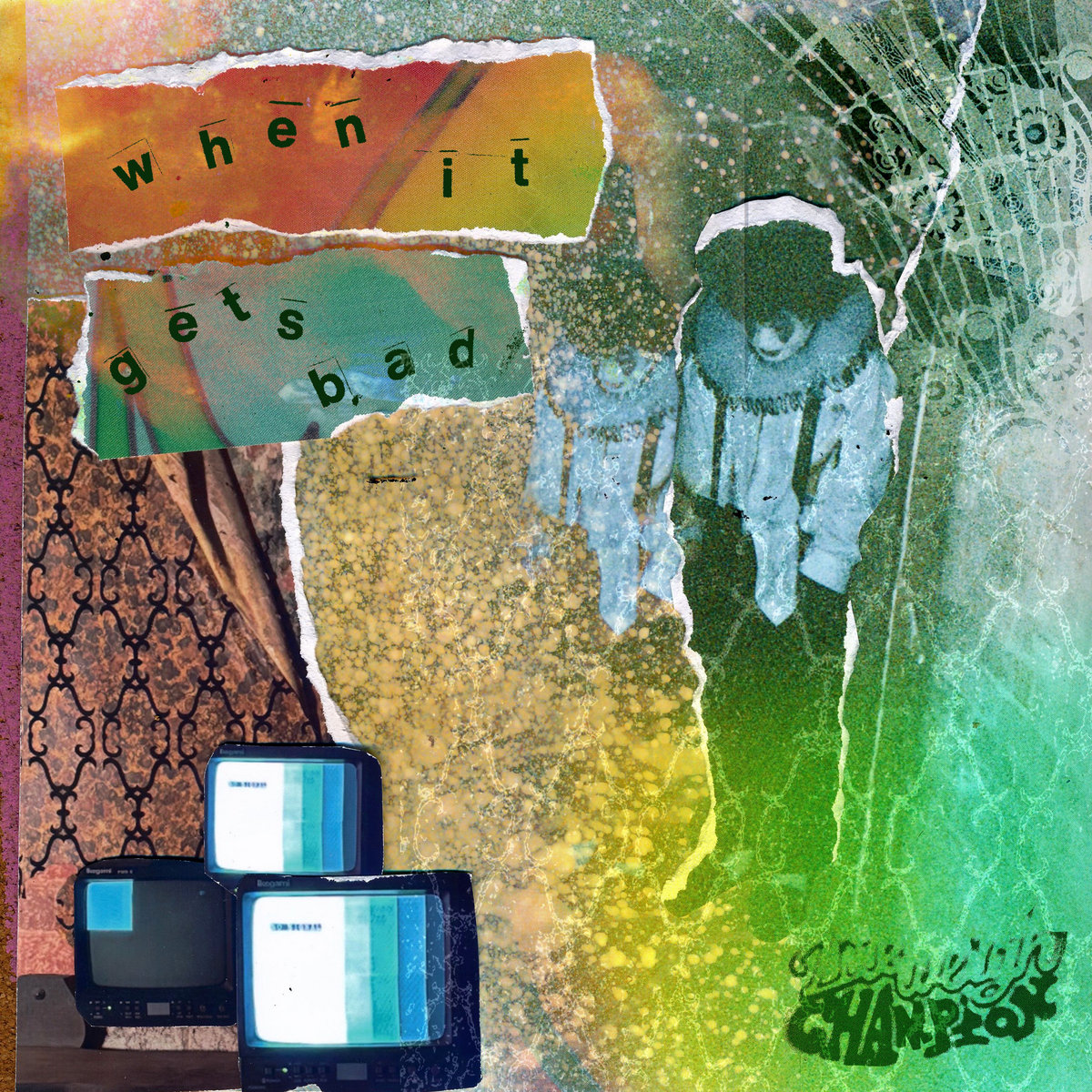
Liteweight Champion – When It Gets Bad
Liteweight Champion are a band from Columbus, Ohio, whose music sits at the intersection of shoegaze, alternative rock, indie rock and a particularly guitar-heavy form of power pop. The current line-up brings together Sean Gleeson, Colin Giacalone, Casey Costello and Sam Gilton, four musicians who seem to have developed a much stronger collective identity during 2026.
Following the release of their self-titled debut album in November 2024, Liteweight Champion considerably increased their activity. The band first released the four-track Monday Afternoon on May 29, 2026, before returning less than two months later with When It Gets Bad on July 24. The new EP contains four tracks, “Euphoria,” “Death Cup,” “Bloody Hell” and “Scorched Earth Serenity,” running for just under twenty minutes.
One of Liteweight Champion’s greatest strengths is their ability to use the familiar vocabulary of shoegaze without allowing the songs themselves to disappear beneath the effects. The guitars are thick, saturated and drenched in reverb, but there are strong melodies underneath them. Behind the layers of noise is a much more direct approach to songwriting that draws equally from indie rock and power pop.
This combination gives When It Gets Bad a particular sense of energy. Liteweight Champion are not simply interested in creating huge walls of sound for the listener to disappear into. The rhythm section provides enough weight and movement to keep the songs pushing forward, while the guitars continually shift between bright melodic passages and considerably heavier bursts of distortion.
The EP was produced and recorded by Sean Gleeson before being mastered by Glenn Davis. Gleeson also provides vocals and plays Fender Jaguar and Jazzmaster guitars, while Colin Giacalone also plays Jazzmaster. Casey Costello handles Fender Jazz bass and Sam Gilton provides drums and vocals. Elijah Jones contributes additional Jazzmaster guitar to “Euphoria,” while Molly Brown provides vocals on “Euphoria,” “Bloody Hell” and “Scorched Earth Serenity.” Karly Ratzenberger also appears vocally on the closing track and provided the photography associated with the release.
“Euphoria” is probably the ideal introduction to this period of Liteweight Champion. The song develops around a highly melodic guitar figure before gradually introducing additional layers of sound. What initially feels relatively open slowly fills with guitars until the track reaches a much greater scale, yet its central melody is never completely swallowed by the distortion.
That contrast is where much of Liteweight Champion’s appeal can be found. Saturation is not being used to disguise the song but to increase its emotional impact. The guitars gradually become larger and more imposing, while the bass and drums maintain enough structure to stop everything from dissolving into reverb. At certain moments there is an almost punk-like urgency beneath the music, even though the surrounding textures remain unmistakably connected to shoegaze.
At four minutes and forty seconds, “Death Cup” gives the band more room to explore the expansive side of their sound. The track allows its dynamics and guitar textures to develop while maintaining the tension between melody and abrasion that runs throughout the EP. Liteweight Champion seem particularly effective when they allow the pressure to accumulate gradually rather than immediately surrounding the listener with an impenetrable wall of noise.
The shorter “Bloody Hell” returns to something more compact and immediate. Once again, it demonstrates that there is a genuine pop instinct underneath the saturated guitars. Even when the production becomes dense, the structure remains clear and the melodies continue to guide the song. This allows Liteweight Champion to retain the physical impact of shoegaze while writing songs that could still work without all the sonic decoration surrounding them.
“Scorched Earth Serenity” closes the EP with its longest track, stretching beyond five minutes. Its title almost perfectly captures the contradiction at the centre of Liteweight Champion’s music, placing destruction and tranquillity alongside one another. That opposition between sonic violence and melodic calm suits a band capable of turning a bright guitar melody into an enormous wave of distortion without making it feel as though the listener has suddenly entered a completely different song.
The additional space offered by “Scorched Earth Serenity” also allows the different textures to breathe. The extra vocals from Molly Brown and Karly Ratzenberger give the arrangement another layer of depth, while the longer structure provides enough room for the band to bring together several aspects of their musical personality. Rather than simply ending the EP with the loudest possible explosion, Liteweight Champion use the track to demonstrate how melody, atmosphere and volume can coexist.
When It Gets Bad also shows how much the band has developed since their 2024 debut. Liteweight Champion now feel increasingly like a fully established group rather than a project centred around a smaller core of musicians. The rhythm section has a clearer identity, while the interaction between the different guitars and additional voices gives the songs considerably more dimension.
Their approach to shoegaze belongs very much to a contemporary generation of bands that no longer treats the genre as a strict collection of rules. The historical vocabulary remains audible through the reverb, fuzz and dramatic shifts in dynamics, but Liteweight Champion freely allow power pop, punk, alternative rock and indie rock to enter the picture.
That openness prevents When It Gets Bad from becoming an exercise in 1990s nostalgia. Liteweight Champion can make dreamy music without becoming passive, use considerable amounts of distortion without sacrificing melody, and create moments of enormous volume without making loudness the sole purpose of the song. It is within that balance that the band increasingly appears to be discovering its own personality.
“Euphoria” remains an excellent entry point because of the way it combines melodic vulnerability with instrumental power, but the other three songs suggest several possible directions for the band. “Death Cup” and particularly “Scorched Earth Serenity” indicate that slightly longer compositions could give Liteweight Champion even more room to explore the contrasts that make their music so effective.
With When It Gets Bad, Liteweight Champion ultimately sound like a band beginning to understand exactly what they can do with their own sound. Their guitars can become enormous, but they are never there simply to impress. Instead, they surround songs that retain their melody, movement and human character beneath all that saturation.
Liteweight Champion may still belong firmly to the underground, but When It Gets Bad has enough personality to make their next steps worth following. When things get bad, as the title suggests, the band do not necessarily offer an easy solution. Instead, they turn up the amplifiers, let the guitars fill the room and, for a few minutes at least, find a way of turning all that noise into something strangely luminous.
© Thusblog