

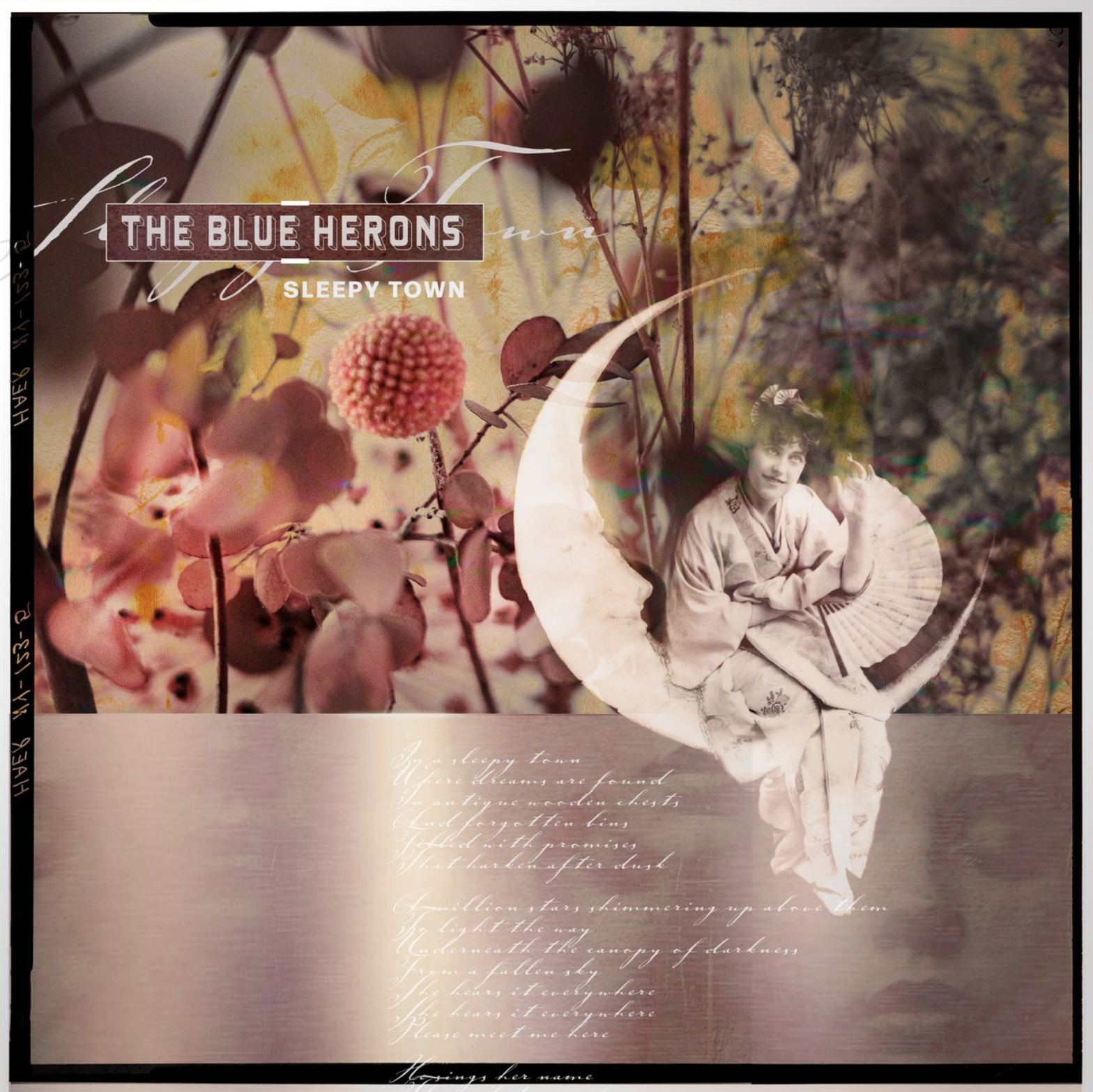
The Blue Herons - Sleepy Town
Some dream-pop songs seem less interested in describing a place than in creating the memory of one. Sleepy Town, the new single from The Blue Herons, has that quality. Its shimmering guitars and melancholy suggest somewhere familiar but slightly unreachable, while the song's underlying concern with what gets hidden, abandoned or left behind gives that apparently peaceful landscape a more ambiguous emotional character.
Released on October 16, 2026 through Shelflife Records, Sleepy Town arrives almost exactly six months after the duo's album Demon Slayer. The song itself has been waiting for approximately as long, making it feel both like an extension of that period and the beginning of whatever The Blue Herons decide to explore next.
Formed in 2020, The Blue Herons is a transatlantic collaboration between Andy Jossi in Switzerland and Gretchen DeVault in the United States. Distance might seem an unusual foundation for music that depends so strongly upon interaction, but their songs have developed a remarkably coherent identity around dream pop, jangle pop and the hazier territory where those styles begin to overlap with shoegaze.
The duo's music is particularly interested in space. Guitars rarely function simply as accompaniment, instead creating environments around DeVault's clear and expressive vocals. This gives The Blue Herons a cinematic quality, with songs that can feel less like conventional narratives than scenes illuminated by particular combinations of sound, colour and emotion.
Sleepy Town places the guitar at the centre of that approach.
Six-string and twelve-string parts intertwine throughout the track, creating the bright, chiming character associated with late-1980s and early-1990s college rock and jangle pop. Rather than disappearing into an enormous shoegaze wall, the individual guitar lines remain perceptible, overlapping until they create a much larger sense of movement.
That clarity is important because The Blue Herons have never needed complete sonic obscurity to create atmosphere. Their dream pop frequently depends upon the opposite principle: details sparkle inside the arrangement, while reverb and layered guitars create distance around them.
There are understandable echoes of The Sundays in the combination of luminous guitar work and an expressive female voice, while comparisons with Alvvays and Hatchie help position The Blue Herons within a more contemporary tradition where jangle pop, indie pop and dream pop comfortably share the same space.
Yet Sleepy Town feels particularly connected to the older jangle tradition. Its guitars possess the brightness and forward momentum of music designed to move rather than simply drift, and Gretchen DeVault's vocals guide that momentum towards an immediately memorable chorus.
This distinction prevents the song from becoming too ethereal for its own good. There is atmosphere everywhere, but underneath it sits a strong pop construction. The chorus is not buried as a reward for listeners prepared to search through layers of effects. It is allowed to arrive openly and provide the song with its emotional centre.
The lyrics introduce a darker shade to that brightness. Sleepy Town touches upon the things people hide away or leave behind and the possibility that connection might still exist somewhere beyond them. The song therefore occupies an interesting space between resignation and hope, recognising absence without entirely accepting isolation.
That tension suits The Blue Herons particularly well.
Jangle pop has often possessed the unusual ability to make melancholy sound almost euphoric, placing sadness inside guitars whose brightness suggests movement and possibility. Sleepy Town uses that contradiction effectively. The music keeps travelling forward even when the emotional perspective is looking backwards.
The title contributes to that ambiguity. A sleepy town can suggest comfort, familiarity and escape from noise, but it can equally describe somewhere in which nothing changes and forgotten things accumulate quietly out of sight. The Blue Herons leave enough space between those possibilities for the listener to decide which version of the town they have entered.
Coming after Demon Slayer, the single also reinforces how clearly the duo have established their musical language. Their songs can move between jangle pop, atmospheric dream pop and hazier jangle-gaze textures without requiring sharp boundaries between them. The common element is melody, particularly the way guitars and vocals interact rather than compete for space.
This is ultimately what makes Sleepy Town work so naturally. The production may evoke a particular period of late-1980s and early-1990s guitar music, but the song does not feel like an exercise in recreating it. The Blue Herons use that vocabulary because its combination of brightness, distance and melancholy remains perfectly suited to the emotions they want to express.
Six years into their collaboration, Andy Jossi and Gretchen DeVault have developed a sound in which nostalgia does not necessarily mean looking backwards. Their guitars can evoke another era while the songwriting remains immediate, and their dream pop can feel spacious without becoming emotionally remote.
Sleepy Town captures that balance particularly well. It is bright enough to invite a sing-along, melancholy enough to leave something unresolved and atmospheric enough to make its few minutes feel like somewhere the listener has briefly visited.
Perhaps that is the most appropriate quality for a song concerned with what has been left behind. The Blue Herons do not try to recover those lost things completely. They simply illuminate them for a moment, surround them with shimmering guitars, and leave the possibility that somewhere beyond the sleepy town, another connection is still waiting.
© Thusblog