
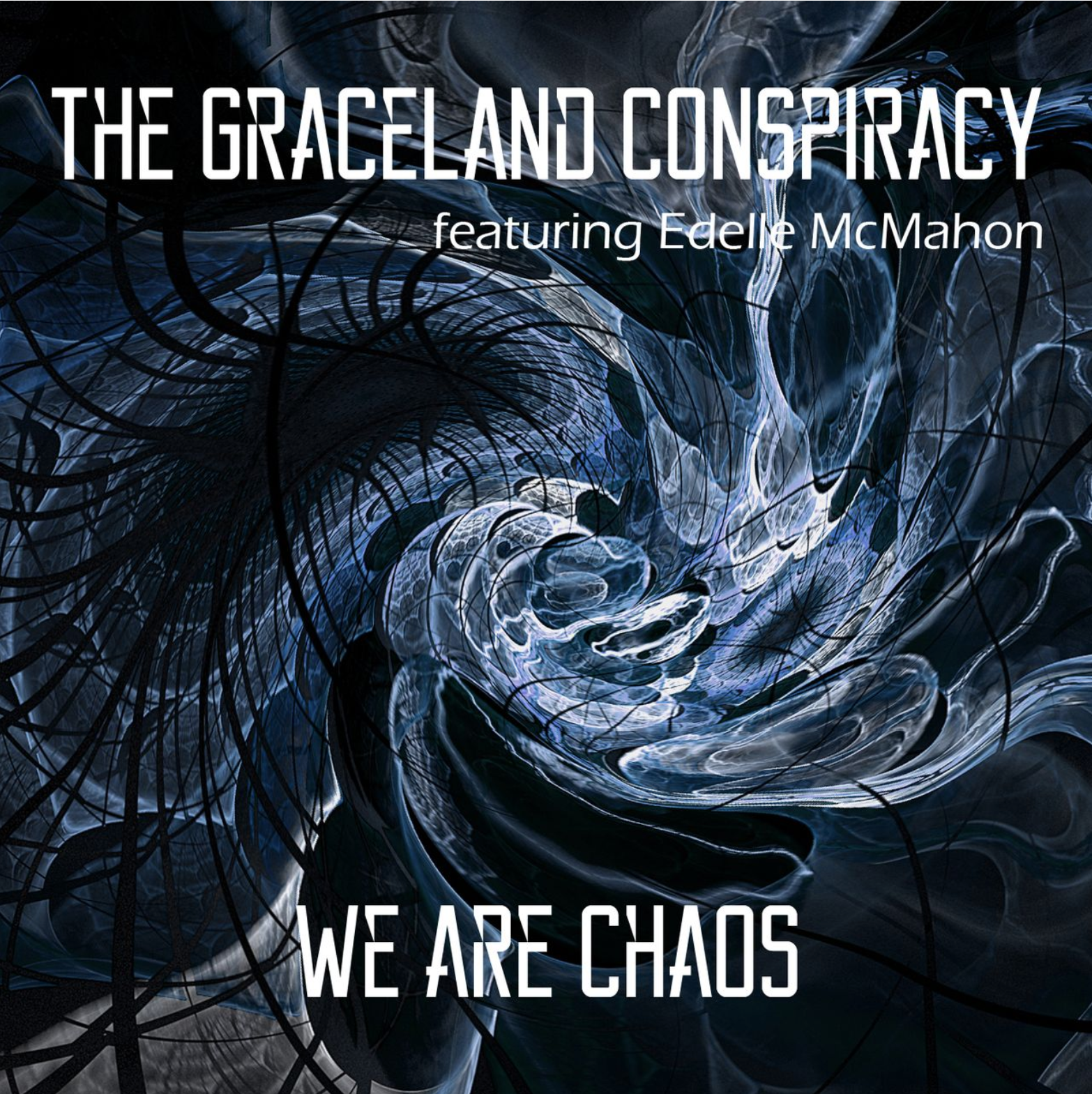
The Graceland Conspiracy - We Are Chaos
There is a certain irony in introducing a new band with a song called “We Are Chaos” when almost everything about the music itself seems carefully designed to create space. The debut single from The Graceland Conspiracy does not rush towards a chorus, announce itself through an enormous guitar entrance or attempt to explain within thirty seconds why the listener should continue paying attention. Instead, piano, acoustic guitar, reversed textures and distant swells are allowed to develop gradually until Edelle McMahon's voice finally enters more than a minute into the piece.
In the contemporary streaming environment, where songs are increasingly encouraged to reveal themselves almost immediately, that patience already feels quietly rebellious.
The Graceland Conspiracy is the new dream-pop project created by Colin Crooks, previously a member of PBR Streetgang, who released several singles through the legendary Northern Irish label Good Vibrations, and currently part of Bad Noise Monster. Anyone familiar with the more abrasive side of Crooks' musical history may therefore be surprised by We Are Chaos. Distortion has not disappeared entirely from his musical vocabulary, but here the emphasis has shifted dramatically towards atmosphere, space and texture.
Crooks plays piano and bass, while McMahon provides the vocals. They are joined by Paul Wilkinson on guitar, Gary Taylor on drums and Jon McKinley on brass, creating a group whose members have crossed paths repeatedly through Northern Ireland's music scene. Wilkinson and McMahon previously played together in the country-rock group Jackson Cage, while Crooks and Wilkinson shared time in The Dollybyrds. Taylor is also currently a member of Bad Noise Monster alongside Crooks.
The Graceland Conspiracy therefore represents a new project rather than a collection of musicians meeting for the first time.
Even the name suggests that they are not approaching the venture with excessive solemnity. The Graceland Conspiracy refers to the wonderfully absurd theory that Elvis Presley never really died and continues to live secretly at Graceland. Yet beneath that playful reference is music that takes atmosphere remarkably seriously.
On We Are Chaos, the group occupies a space somewhere between dream pop, ambient folk and atmospheric alternative music. Comparisons with the dreamlike qualities of Cocteau Twins and the more minimal, organic side of Sigur Rós provide useful coordinates, but the most interesting aspect of the song is not necessarily who it resembles. It is the freedom with which The Graceland Conspiracy allows the composition to determine its own shape.
There is no obvious attempt to force the music into a conventional verse-chorus-verse structure.
Instead, the song unfolds.
A delicate piano introduces the piece before acoustic guitar begins filling some of the space around it. Behind these recognisable instruments, shimmering sounds gradually emerge, while reversed guitars seem to move in directions that are difficult to locate precisely. They do not behave like conventional guitar parts so much as currents passing through the recording.
For more than a minute, there is no voice at all.
That decision is important because the instrumental introduction is not merely waiting for the song to begin. It is already the song. The Graceland Conspiracy allows the listener to enter the environment before providing a narrative voice within it, and when Edelle McMahon eventually appears, her vocal feels less like something placed above the arrangement than another element emerging from inside it.
Gary Taylor's drums arrive around the same time and provide the music with a subtle pulse without disturbing its spacious character. The performance remains restrained, but the introduction of live drums gives the surrounding textures something physical to move against.
That element became particularly important during the unusually extended history of the recording.
We Are Chaos was recorded at Earth Music in Belfast with Vic Fulton-Bronzini, but the original version contained programmed drums that Crooks felt never quite worked. Rather than releasing something that did not completely satisfy him, the track was shelved. Time passed, musicians became involved with other projects and the song effectively remained suspended until Crooks eventually returned to Earth Music and resurrected it.
Gary Taylor's live drums proved to be one of the missing pieces.
It is easy to understand why. A song concerned with natural forces and the invisible movements shaping our lives benefits enormously from a rhythm that feels human rather than mechanically imposed. Taylor does not suddenly turn We Are Chaos into a conventional rock song. Instead, his playing gives the music a heartbeat.
The distinction is subtle but essential.
McMahon's lyrics arrive in two principal sections and revolve around natural forces, movement and the invisible push and pull existing around human lives. Rather than presenting chaos purely as destruction or disorder, the song appears interested in recognising it as something fundamental to existence. Forces beyond our control continually alter direction, relationships and circumstances, whether we recognise their influence or not.
The music responds to that idea beautifully because it rarely feels rigid.
Sounds appear, recede and overlap. Reversed guitars create the sensation of movement occurring in the wrong direction, while the piano provides something more stable at the centre. The acoustic guitar introduces an organic quality, the drums provide a pulse and McMahon's voice becomes the element around which these different forces temporarily gather.
By the time Jon McKinley's brass enters towards the end, the composition has travelled a considerable distance without ever requiring an obvious dramatic explosion. The horns add emotional weight and another layer of texture, but they do not behave like a traditional climax. Instead, they widen the landscape one final time.
There is something almost elemental about the completed recording.
Despite the considerable amount of texture surrounding it, We Are Chaos never feels excessively produced. Piano, acoustic guitar, voice, drums and brass remain recognisably human instruments, while the reversed guitars and ambient swells blur their surroundings. The combination creates the peculiar impression of something simultaneously constructed and organic.
That contradiction is particularly appropriate for a song about chaos.
What is perhaps most encouraging about The Graceland Conspiracy is that the group appears willing to allow this approach to determine not only its music but also the way that music is presented.
The band has deliberately chosen not to participate fully in the usual streaming ecosystem. Rather than placing We Are Chaos everywhere simply because contemporary release strategy suggests that every platform must be fed simultaneously, the track is being made available primarily through Bandcamp, alongside a lyric video on YouTube.
There are no conventional promotional photographs accompanying the release either, with the group preferring artwork to the familiar requirement that every new musical project immediately establish a recognisable visual brand.
In isolation, those decisions might appear relatively minor. Together, however, they say something interesting about what The Graceland Conspiracy wants to be.
Modern musicians are increasingly expected to become permanent content creators alongside being musicians. A song is no longer necessarily sufficient; it requires clips, photographs, posts, teasers, vertical videos and a continuing stream of material designed to keep both audiences and algorithms attentive. The Graceland Conspiracy appears considerably less interested in participating in that machinery.
There is something refreshingly consistent about making music that refuses to hurry and then refusing to hurry the listener towards it.
That philosophy is audible throughout We Are Chaos. The song does not behave as though it is frightened of losing attention. It trusts its atmosphere enough to spend more than a minute establishing itself before the vocals arrive. It trusts quiet instruments enough not to bury them beneath unnecessary volume, and it trusts the listener enough not to provide an immediately recognisable chorus as reassurance.
This does not make the song deliberately difficult. In fact, much of it is remarkably accessible and beautiful.
It simply means that The Graceland Conspiracy values immersion more than immediacy.
That distinction may prove important if We Are Chaos genuinely represents the direction of the project rather than an isolated experiment. There is considerable territory available between dream pop, atmospheric folk, psychedelia and more abstract forms of alternative music, particularly for musicians who are not concerned with making every composition conform to the same structure.
The group's collective experience should also make that exploration particularly interesting. These are musicians who have already spent considerable time inside louder and more conventional band formats. Their restraint therefore feels intentional rather than tentative.
Nobody appears afraid of making noise.
They simply understand that noise becomes more powerful when silence and space are available around it.
As a debut single, We Are Chaos consequently achieves something more valuable than immediately defining everything The Graceland Conspiracy might become. It establishes a philosophy. Songs can take the time they require. Instruments can enter when they have something meaningful to contribute. Atmosphere can become part of the composition rather than decoration surrounding it, and a recording does not necessarily have to obey the structural expectations inherited from rock and pop.
Most importantly, The Graceland Conspiracy seems willing to let the music exist without immediately turning the band itself into a product that requires constant explanation.
There is a pleasing contradiction at the centre of all this. A project named after a ridiculous Elvis conspiracy has introduced itself with a song contemplating the invisible forces shaping human existence, performed with remarkable restraint by musicians whose histories include considerably louder forms of rock music.
Yet perhaps the biggest contradiction is contained within the title itself.
We Are Chaos does not sound chaotic in the conventional sense. It sounds like five musicians recognising that chaos can also exist in the gradual movement of things that cannot be completely controlled: a guitar travelling backwards through a melody, a voice appearing from an instrumental landscape, live drums giving new life to a recording that had previously been abandoned, or musicians from different projects eventually finding themselves together in another one.
For The Graceland Conspiracy, chaos is not necessarily the sound of everything collapsing at once.
Sometimes it is simply what happens when you stop forcing everything to follow the expected path and allow the music to find its own way.
© Thusblog