
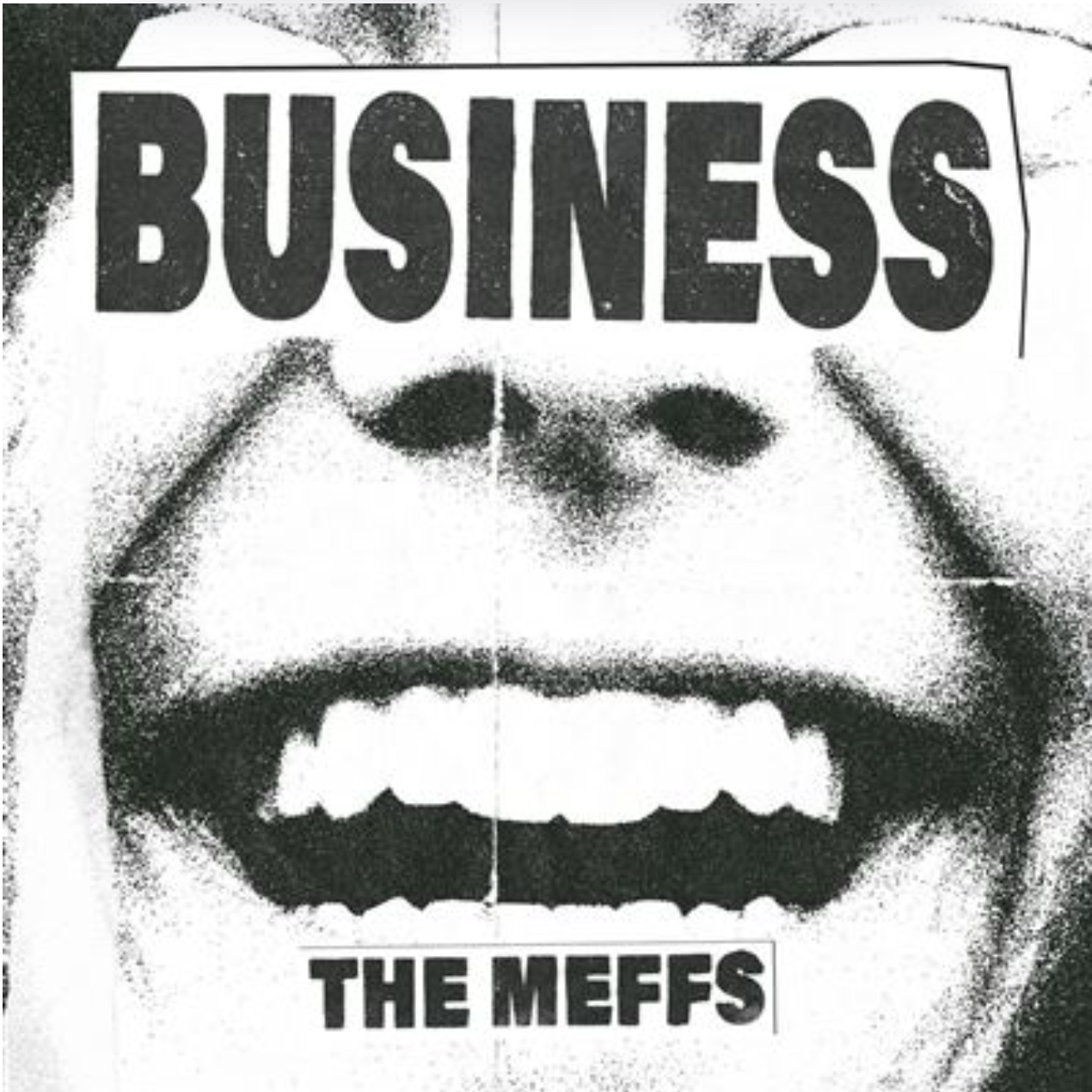
The Meffs - Business
There has always been something wonderfully unreasonable about The Meffs. Two musicians, one guitar and one drum kit should impose certain physical limitations, yet Lily Hopkins and Lewis Copsey have spent much of their existence behaving as though nobody remembered to tell them. Their description of themselves as “louder than a four-piece” initially sounds like typical punk bravado, but listen to their second album Business at sufficient volume and it begins to resemble a fairly accurate technical specification.
Released on September 11, 2026 through FLG, Business takes the fundamental economy of The Meffs' music and makes virtually everything surrounding it bigger. The guitars are heavier, Copsey's drums carry considerably more physical weight and Hopkins sounds increasingly comfortable moving between melody, confrontation and outright fury. Eleven songs pass in approximately 26 minutes, with almost nothing resembling unnecessary decoration.
Yet the most significant expansion has occurred in the writing.
If 2024's What A Life established The Meffs as one of the more exciting young British punk bands, Business feels considerably more interested in examining the environment in which that band now exists. Work, money, nationalism, corporate power, technology, war, identity and the music industry all enter the picture. The album is angry, certainly, but its anger rarely exists simply for the pleasure of shouting.
Something is usually underneath it.
The story of The Meffs begins in Essex, where Hopkins and Copsey already knew each other by sight before they became musical partners around 2019 and 2020. The origin story is appropriately uncomplicated. Hopkins saw a photograph of Copsey sitting behind a drum kit and asked him about forming a band.
Sometimes rock history does not require an elaborate mythology.
Their musical connection quickly revealed a shared attraction to punk, hardcore and direct forms of rock music. Hopkins' early influences included Nirvana and The Offspring, while the broader vocabulary surrounding The Meffs would eventually encompass everything from Sham 69 and X-Ray Spex to Soft Play, hardcore, garage rock and considerably heavier forms of alternative music.
The important point is that The Meffs never seemed particularly interested in becoming historical preservationists.
British punk possesses an enormous legacy, but that legacy can become a burden when younger groups concentrate so heavily on reproducing its sound, clothes and attitudes that they forget punk was supposed to respond to the conditions surrounding it. The Meffs instead use that history as raw material. Their music can contain the blunt economy of late-1970s punk without pretending that the last five decades never happened.
The two Broken Britain EPs established that combination of physical immediacy and social observation before the group's relationship with Frank Turner accelerated its development. Turner produced important early material, subsequently passed their music to Fat Mike of NOFX, and The Meffs eventually became associated with his Bottles To The Ground label. Turner also produced What A Life, their first full-length album.
By the time Business arrived, however, the circumstances surrounding the band had changed considerably.
The Meffs had moved from small venues towards much larger audiences, touring extensively across Britain and Europe and appearing alongside artists including Sex Pistols featuring Frank Carter, The Undertones, Alice Cooper, The Damned, Stiff Little Fingers, Frank Turner and Joan Jett. Festival appearances at Glastonbury, Download and 2000 Trees during 2025 placed their deliberately minimal setup on stages where its physical effectiveness could be properly tested.
That experience feeds directly into Business.
This is an album designed by musicians who now understand exactly what happens when their songs leave the rehearsal room and encounter an audience. The arrangements are economical because there is little reason for them not to be. Riffs arrive quickly, drums hit hard and songs generally disappear before their central idea has time to become exhausted.
The change from Frank Turner to Dan Weller, guitarist with SikTh and an experienced producer, proves particularly effective.
Weller does not attempt to civilise The Meffs.
Instead, he enlarges them.
The fundamental guitar-and-drums architecture remains intact, but Hopkins' instrument sounds considerably broader and Copsey's kit possesses the kind of depth that makes the absence of additional musicians almost irrelevant. There are moments when Business feels less like a duo attempting to compensate for missing instruments than a deliberate argument that those instruments were never necessary in the first place.
The production therefore understands one of The Meffs' most important characteristics: simplicity and smallness are not the same thing.
Opening track “Dreamin'” barely passes the one-minute mark, immediately establishing the album's refusal to waste time. What A Nightmare and Where Did It All Go Wrong? continue that momentum, while elsewhere “Fight” compresses the punk impulse into approximately thirty seconds. Even the relatively expansive Disorder (Wake Up) and closing Like Gravity only move slightly beyond three minutes.
There is no prestige attached to duration here.
A song lasts as long as the impact requires.
Yet beneath this economy, Business develops a surprisingly broad interpretation of its title.
Business is obviously the music business, but it is also the business of modern life. It is employment, politics, economics, war, healthcare, technology and the increasingly complicated relationship between individuals and the organisations possessing power over them. The word becomes deliberately slippery because almost everything now appears capable of becoming somebody's business model.
People included.
That idea becomes explicit on the title track.
“Business” turns its attention towards an industry that continually encourages musicians to present themselves as authentic while simultaneously attempting to determine which forms of authenticity can be successfully marketed. The contradiction is particularly relevant to The Meffs because Hopkins has described the conflicting expectations placed upon the group: too abrasive for one audience, insufficiently abrasive for another, too queer or somehow not queer enough, depending upon whichever category somebody wants them to occupy.
The absurdity is obvious.
Authenticity stops being authentic the moment somebody hands you the specifications.
For The Meffs, the response is not to locate the perfect marketable identity but to resist the premise itself. The title track therefore works simultaneously as criticism of the industry and declaration of independence from the categories it attempts to impose.
That concern with identity and power extends considerably beyond music.
“What A Nightmare” confronts the renewed visibility of British nationalism and the nostalgic fantasy that the country can somehow be returned to an imagined earlier state. Hopkins has spoken about noticing the proliferation of British flags and rhetoric surrounding the idea of “taking the country back,” observations that acquire additional significance because The Meffs come from Essex, an environment whose political changes are impossible to separate entirely from the song.
The band's response is rooted in the contradiction between nostalgic nationalism and the reality of contemporary Britain.
The country being discussed in these slogans is already multicultural, socially complicated and irreversibly shaped by generations of migration and cultural exchange. The imagined Britain supposedly waiting to be recovered therefore has an increasingly uncertain relationship with the Britain that actually exists.
The Meffs attack that contradiction with punk rather than political theory.
That is important because Business works best when it remains music rather than becoming a collection of position papers accompanied by distortion. Hopkins can be direct, but Copsey's drums and the physical scale of the guitar ensure that the arguments are experienced as much as understood.
“Law” turns towards inequality and authority, while “So Modern (Keep Up)” addresses another exhausting feature of contemporary life: the constant instruction to adapt.
Keep up with technology.
Keep up with economic change.
Keep up with work.
Keep up with whatever platform, system, trend or corporate language has suddenly become unavoidable.
Modernity is presented less as liberation than as a treadmill whose controls are permanently being accelerated by somebody else.
There is something particularly appropriate about punk addressing that sensation because the genre has historically depended upon reducing things rather than continually adding them. While modern culture demands more platforms, more productivity, more visibility and more content, The Meffs answer with guitar, drums and songs that sometimes struggle to reach two minutes.
Their minimalism almost becomes part of the argument.
“God Complex,” featuring German punk band Donots, pushes the album towards an even larger sound without disturbing that fundamental directness. It demonstrates that Business can expand beyond the duo's usual physical dimensions while preserving the aggression at its centre.
But an album consisting exclusively of confrontation would eventually become predictable, however forcefully it was played.
This is where the vulnerability Hopkins associates with Business becomes essential.
Behind many of these songs is not simply anger but exhaustion. The political and economic structures being criticised feel enormous precisely because individuals frequently feel so small beside them. Anxiety, frustration and helplessness repeatedly appear beneath the slogans, suggesting that fury is often the final stage of a considerably more complicated emotional process.
People become angry because something matters and they cannot see how to change it.
That makes the resistance running through the record more convincing. The Meffs are not presenting themselves as people standing outside society with all the answers. They sound caught inside the same machinery as everybody else, attempting to understand it while simultaneously refusing to accept that its operation is inevitable.
Punk becomes a method of converting powerlessness into movement.
A room full of people shouting the same line does not automatically change the political or economic system outside the venue, but for several minutes it transforms isolation into something collective. That has always been one of punk's most enduring functions, and The Meffs understand it instinctively.
The closing “Like Gravity” becomes particularly important because it prevents Business from finishing as a simple accumulation of grievances.
There is more vulnerability here, providing the album with an emotional perspective that makes the preceding aggression feel less uniform. The heaviness remains, but its purpose changes. By this point, The Meffs have spent most of the record pushing outward against institutions, expectations and frustrations. The final moments allow some of that pressure to turn inward.
It reveals something that has actually been present throughout the album.
The Meffs are not angry because they have stopped caring.
They are angry because they haven't.
That distinction is fundamental to Business.
The album's politics would be considerably less interesting if they existed purely as slogans, just as its music would become exhausting if every song simply attempted to be faster and louder than the previous one. Instead, the record finds its tension in the distance between the size of the problems being described and the deliberately restricted resources being used to confront them.
Two people.
One guitar.
One drum kit.
Twenty-six minutes.
Against an entire world of business.
There is also something increasingly distinctive about the way The Meffs occupy the landscape of contemporary British punk. They are clearly connected to its history, but they do not sound particularly interested in reconstructing it. Hardcore, alternative rock, garage and occasional near-metallic weight have become part of their language, while Hopkins' melodic instincts prevent even the most aggressive songs from becoming completely blunt instruments.
The result is recognisably British punk without sounding trapped inside somebody else's memory of what British punk is supposed to be.
That may be the most significant development from the Broken Britain EPs through What A Life and now Business. The Meffs have not radically reinvented their formula because there was never much wrong with the formula in the first place.
Instead, they have densified it.
The guitar has become heavier. The drums have become larger. The production possesses more depth and the writing has become more explicit about the forces producing the frustration behind it. At the same time, years of touring have taught Hopkins and Copsey exactly how little they require to create maximum impact.
There is something almost perversely satisfying about that economy.
The world described by Business continually demands more: more work, more adaptation, more consumption, more marketability, more willingness to accept the next set of rules.
The Meffs respond by stripping everything back until almost nothing remains except the essentials.
And then they turn those essentials up extremely loud.
© Thusblog
Listen on Qobuz Hi-res (24-bit)
Watch The Meffs live:
03/10/2026 North East Calling Northumbria University Newcastle upon Tyne GB
10/10/2026 Cretin Hop Festival La Boissière-de-Montaigu FR
16/10/2026 Live Music Hall Köln DE (supporting Levellers)
17/10/2026 Muziekgieterij
18/10/2026 The Depot Leuven NL (supporting Levellers)
20/10/2026 The Picturedome Holmfirth UK (supporting Levellers)
22/10/2026 Mandela Hall Belfast UK (supporting Levellers)
23/10/2026 Vicar Street Dublin IE (supporting Levellers)
24/10/2026 Barrowland Ballroom Glasgow UK (supporting Levellers)
29/10/2026 York Barbican York UK (supporting Levellers)
30/10/2026 Venue Llandudno
06/11/2026 Substage
07/11/2026 Sputnikhalle
08/11/2026 M.A.U. Rostock
10/11/2026 TOWER Musikclub Bremen DE
11/11/2026 The Pump Kiel DE
12/11/2026 Kleine Freiheit Osnabrück DE
13/11/2026 Capitol Hannover Hannover DE (supporting Itchy)
14/11/2026 Beatpol Dresden
19/11/2026 Rock City Nottingham UK (supporting Levellers)
20/11/2026 The Prospect Building Bristol UK (supporting Levellers)
21/11/2026 Eventim Apollo London UK(supporting Levellers)
12/12/2026 The Adrian Flux Waterfront Norwich UK (supporting Sham 69)