
Wayfarer - Riders Of The Setting Sun
The American West has always occupied a peculiar place in popular imagination, a landscape associated with freedom, adventure and the promise of new beginnings. Yet beneath those romantic images lies a far more complicated history of violence, exploitation, isolation and shattered ambitions. For Wayfarer, the Denver-based quartet who have spent more than a decade exploring the darker side of American mythology, that contradiction has become the foundation of an increasingly distinctive musical identity.
Released today, November 20, 2026, through Vesperian, Riders Of The Setting Sun is the band's sixth studio album and another significant development in their journey from atmospheric black metal towards a more expansive sound incorporating gothic country, post-punk, dark Americana and cinematic western influences.
Formed in Denver, Colorado, in the early 2010s, Wayfarer initially established themselves through lengthy compositions, heavily distorted guitars and the melancholic intensity of atmospheric black metal. However, their fascination with the landscapes and troubled history of the American frontier gradually encouraged them to explore musical traditions far removed from the conventional boundaries of extreme metal.
Albums such as World's Blood (2018), A Romance With Violence (2020) and particularly American Gothic (2023) documented that transformation. The latter introduced a stronger emphasis on western melodies, gothic rock atmospheres and rhythmic arrangements inspired by traditional American music, establishing a direction that continues to develop on their latest release.
The current lineup features Shane McCarthy on vocals and guitars, Joe Strong-Truscelli on guitars, James Hansen on bass and Isaac Faulk on drums. Their instrumental contributions extend beyond those primary roles, incorporating piano, slide guitar, organ, synthesizers, percussion and additional vocals, allowing the band to create arrangements that move freely between heavy rock and more atmospheric territory.
With Riders Of The Setting Sun, Wayfarer appear increasingly interested in the emotional possibilities of restraint. Rather than relying exclusively upon overwhelming guitars and the dramatic intensity of black metal, the music embraces slower passages, spacious arrangements and an atmosphere shaped by the desolate imagery of the American frontier.
The album evokes abandoned industrial landscapes, endless highways and communities marked by decline, presenting the West not as an untouched wilderness but as a place haunted by the consequences of its own history.
Its title provides an appropriate metaphor for that perspective. The setting sun suggests the disappearance of an era, the exhaustion of familiar ideals and the uncertain possibility of something emerging after darkness falls.
These images are accompanied by themes of departure, betrayal, regret and the difficult relationship between personal choices and their consequences. Wayfarer's fascination with historical narratives becomes inseparable from more intimate reflections on loss and disillusionment.
The album's musical direction also reflects an interesting convergence of influences.
Gothic country contributes its storytelling traditions, melancholy and sense of rural isolation, while post-punk introduces colder textures, repetitive guitar patterns and an underlying tension. The band's black metal origins remain present in the dramatic contrasts and occasional instrumental weight, but they increasingly function as one element within a broader musical vocabulary.
The resulting atmosphere suggests connections with the darker Americana of Wovenhand, the experimental gothic sensibility of Chelsea Wolfe and the cinematic qualities associated with alternative western soundtracks, without reducing Wayfarer's identity to any particular influence.
The album's production reinforces this expanded approach.
Wayfarer collaborated with Ben Chisholm, known for his work with Chelsea Wolfe, alongside James Barone, associated with Beach House, and Iver Sandøy of Enslaved, who contributed to the recording and mixing process. Mastering was handled by Alan Douches.
These different backgrounds reflect the album's musical ambitions, bringing together experience from atmospheric metal, experimental rock and dreamlike alternative music.
Several notable guests also appear, including David Eugene Edwards of 16 Horsepower and Wovenhand, Steve Von Till of Neurosis, Munly J. Munly, Kelly Schilling of Dreadnought and Midwife.
Their involvement strengthens the connection between Wayfarer's established sound and the broader traditions of gothic Americana and experimental music.
Among the album's key compositions, “Perdition's Crossing” features David Eugene Edwards, whose work has played an important role in defining the darker possibilities of American folk and gothic country. His participation feels particularly appropriate given Wayfarer's growing interest in the relationship between traditional musical imagery and contemporary darkness.
“Hollow Hearts On The Trail To Eden,” also introduced through an accompanying video, explores a more explicitly narrative direction. The song follows a solitary traveller confronting regret and the consequences of past decisions as winter approaches. Its dramatic development and concluding guitar solo reinforce the cinematic qualities that have become increasingly central to the band's songwriting.
Another particularly revealing choice is the inclusion of “Casey's Last Ride,” originally written by Kris Kristofferson. By incorporating a song from the American country tradition, Wayfarer acknowledge an important part of the musical heritage that now informs their work, while placing it within their own darker aesthetic.
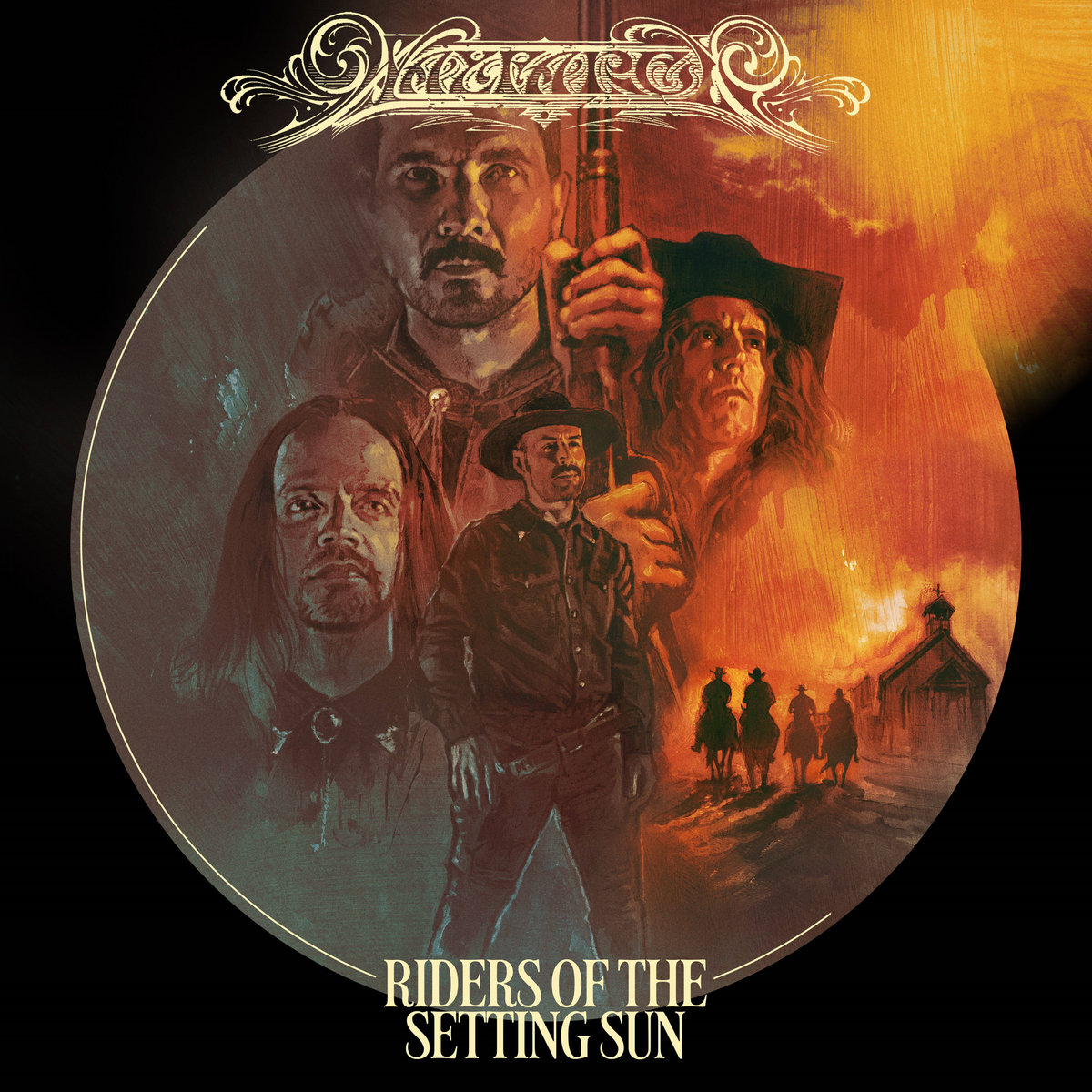
The album's visual presentation contributes to this sense of continuity between music and western mythology. Its artwork was created by Tony Stella, the celebrated illustrator whose work draws upon the tradition of classic cinema posters. Completed among his final projects before his death in 2026, the cover reinforces the record's connection with the imagery of an older American West.
What makes Riders Of The Setting Sun particularly intriguing is the way Wayfarer continue to reinterpret that imagery rather than simply reproduce it.
Their vision of the frontier is neither heroic nor nostalgic. It is populated by damaged characters, fading ambitions and landscapes carrying the marks of human activity. The music reflects those contradictions through arrangements that move between beauty and unease, allowing moments of relative calm to coexist with darker, more imposing passages.
Twenty-first-century America may be far removed from the historical period traditionally associated with the western, but the themes of exploitation, displacement and disillusionment remain recognisable. Wayfarer use the genre's imagery to explore those connections without reducing their songs to straightforward historical commentary.
Following the increasingly ambitious American Gothic, Riders Of The Setting Sun represents another important stage in the band's evolution. Their black metal foundations have not disappeared, but they now coexist with a wider range of influences, allowing gothic country, post-punk and atmospheric rock to play a more prominent role.
Wayfarer have developed a musical language in which the American frontier becomes both a historical landscape and an emotional state, a place where the promise of freedom is continually confronted by the weight of the past.
With Riders Of The Setting Sun, the Denver quartet continue to challenge the romantic mythology of the West, replacing its familiar heroes with more uncertain figures travelling through a world approaching dusk.
The result is a compelling new chapter in Wayfarer's exploration of dark Americana, where the fading light of the western horizon reveals as much about the present as it does about the past.
© Thusblog