
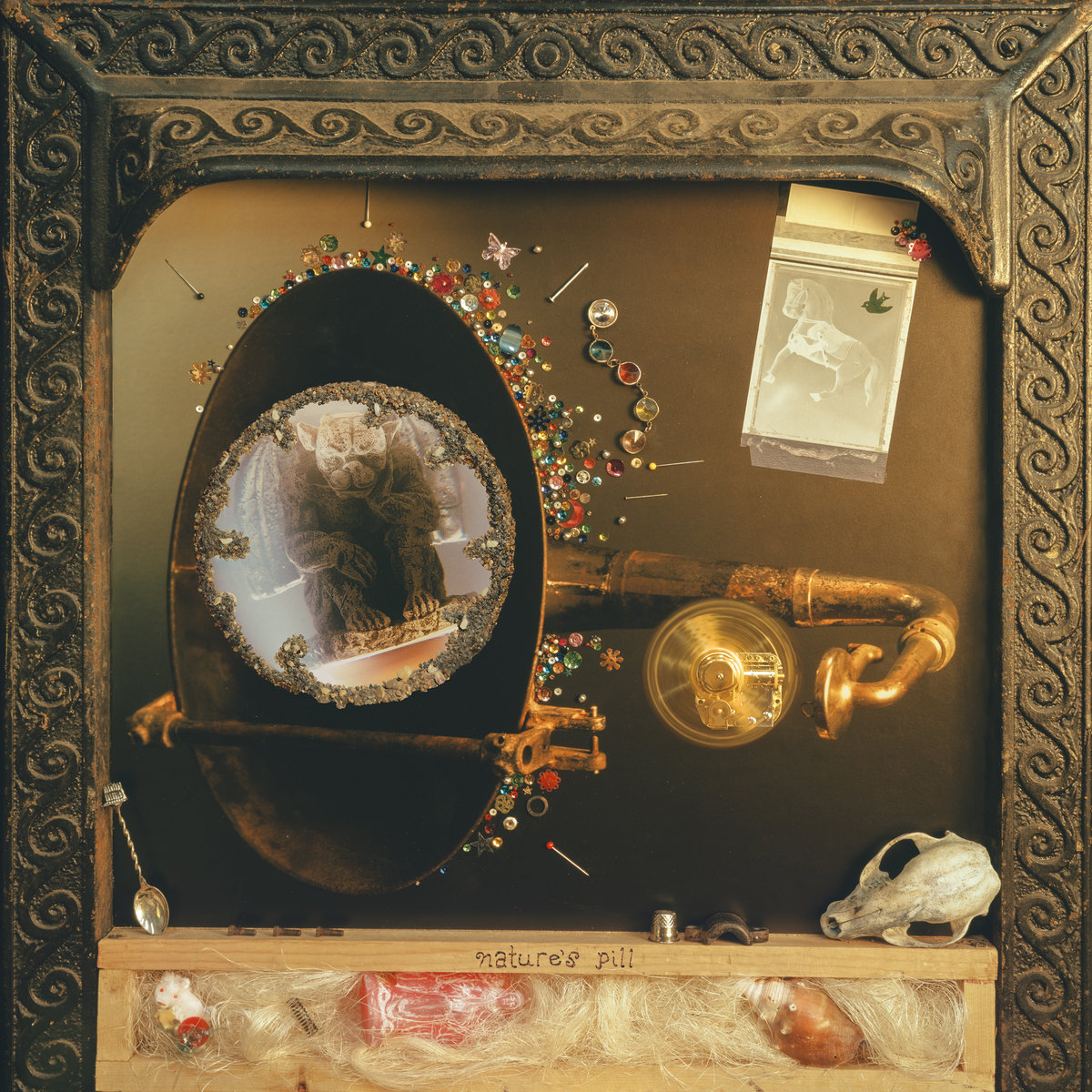
Wishy - Nature’s Pill
There comes a point when a band influenced by shoegaze has to decide whether the wall of sound is the song or simply one of the tools available to build it. On their second album, Nature’s Pill, Wishy increasingly choose the latter. The fuzz, distortion and dreamlike atmosphere remain, but the Indianapolis group now seems more interested in what happens when those textures are wrapped around melodies designed to survive without them.
Released on October 2, 2026 through Winspear, Nature’s Pill follows the group's 2024 debut Triple Seven and the 2025 EP Planet Popstar. Across twelve songs, Wishy move between indie pop, dream pop, shoegaze, power pop, jangle pop and alternative rock, creating a record that remains unmistakably connected to 1990s guitar music while sounding increasingly confident about its own melodic identity.
Wishy is built principally around the creative partnership of Kevin Krauter and Nina Pitchkites, both of whom sing and play guitar, alongside Dimitri Morris on guitar, Mitch Collins on bass and Conner Host on drums. Krauter was previously a member of Indiana indie-pop group Hoops, but his musical connection with Pitchkites stretches considerably further back. The pair have known each other since high school and moved through many of the same Indianapolis musical circles before eventually building Wishy together.
That familiarity has become one of the group's greatest strengths. Krauter and Pitchkites do not simply alternate as singers. Their contrasting voices and songwriting instincts allow Wishy to change character without losing continuity, moving from more energetic guitar pop towards softer dream-pop passages or allowing both approaches to coexist inside the same song.
The group first attracted wider attention in 2023 through the Mana and Paradise EPs before Triple Seven established its distinctive mixture of shoegaze guitars, power-pop melodies and 1990s indie rock. There was already something particularly effective about the way Wishy could place enormous guitar textures around songs that might otherwise have belonged to a considerably cleaner form of indie pop.
Nature’s Pill does not abandon that formula, but it adjusts the proportions.
The shoegaze component remains important, yet the songs increasingly place hooks, choruses and melodic immediacy at the centre. Instead of allowing atmosphere to determine the shape of a composition, Wishy often reverse the process: the song establishes itself first and the fuzz, reverb and distortion expand the emotional environment surrounding it.
This makes Nature’s Pill less a conventional shoegaze album than a particularly saturated indie-pop and power-pop record that speaks shoegaze fluently.
That distinction becomes important because Wishy's relationship with the 1990s is unusually broad. Ride may provide one obvious reference for the intersection between melody and guitar density, but the group's instinct for bright, immediate songwriting can also recall the power-pop warmth of Teenage Fanclub. Elsewhere, jangle pop, slacker indie and traces of twee coexist with considerably heavier guitar production.
There are moments where the combination can evoke the more exuberant side of The Pains of Being Pure at Heart, another band that understood how naturally indie pop could function when surrounded by shoegaze volume. Yet Wishy rarely sound interested in reconstructing a particular year or scene. Their influences are obvious, but the songs possess too much enthusiasm for the present to feel trapped by nostalgia.
“All The Rage” demonstrates the importance of Krauter and Pitchkites particularly well. Their vocal interplay becomes part of the song's momentum, while the surrounding jangle and power-pop energy makes the track feel immediate without requiring the guitars to become polite.
“Mona Lisa” approaches their relationship differently, using the interaction between their voices to build towards a chorus whose apparent simplicity gradually reveals additional layers. That ability to make complexity feel casual is one of Wishy's most appealing qualities. Their arrangements can contain considerable detail without advertising how carefully they have been constructed.
Elsewhere, “Sensational” pushes more decisively towards immediate pop-rock, while “Lovesick” practically announces the album's emotional territory through its title alone.
Romantic frustration, desire, obsession and everyday melodrama run throughout Nature’s Pill, but Wishy rarely approach these subjects through detailed narrative songwriting. Krauter and Pitchkites are often more interested in fragments: an image, a feeling or a phrase capable of suggesting a larger emotional history without explaining everything surrounding it.
That approach fits dream pop particularly well.
A song does not necessarily have to describe a specific memory in order to create the sensation of remembering something. Wishy's melodies can produce a peculiar form of second-hand nostalgia, where the listener recognises the emotional shape of an experience without necessarily sharing the events that created it. The guitars then exaggerate that sensation, surrounding relatively simple feelings with an almost disproportionate scale.
There is something very 1990s about this, but not merely in the choice of pedals or guitar tones. Nature’s Pill remembers a period when alternative rock could be noisy, strange and slightly scruffy while still being unapologetically interested in the possibilities of a great chorus.
The production reinforces that balance. Nature’s Pill was produced by Ben Lumsdaine and Kevin Krauter, with Lumsdaine also handling the mix and Greg Obis mastering the album. Rather than polishing away the group's fuzzier characteristics, the record allows distortion and clarity to coexist. The guitars can become dense without making the melodic architecture underneath them difficult to locate.
This also reflects Wishy's increasing experience as a live band. The musicians sound less like separate components arranged around songs and more like a group whose identity has been shaped by repeatedly playing together. That collective confidence may explain why the album can move beyond some of the more contemplative qualities of Triple Seven without losing the atmosphere that initially made Wishy distinctive.
The shift is subtle but important. Where Triple Seven often seemed fascinated by the possibilities of shoegaze itself, Nature’s Pill sounds more comfortable treating shoegaze as one colour within a considerably larger palette.
That does not necessarily make the new record lighter. Wishy's songs remain full of romantic confusion, frustration and melancholy, but those emotions are frequently accompanied by music capable of sounding almost euphoric. Desire becomes louder than disappointment, and even emotional chaos can arrive attached to a melody that refuses to leave.
That contradiction may be the album's most convincing quality.
Nature’s Pill is ultimately a record about Wishy becoming less concerned with demonstrating what kind of band they are. Shoegaze, dream pop, indie rock, jangle and power pop no longer feel like separate influences competing for space. They simply become different ways of making the songs work.
For a group so clearly fascinated by the sounds of the past, Wishy consequently seem remarkably uninterested in remaining there. Nature’s Pill takes the haze and distortion associated with shoegaze and places them around increasingly confident pop songwriting, allowing the hooks to become clearer without making the guitars any smaller.
Perhaps that is the real progression from Triple Seven. Wishy have not moved away from the fog. They have simply discovered that a great melody does not need to disappear inside it.
© Thusblog