
Youth Valley - As Passive Aggressive As It Gets
There is something particularly revealing about the title of Youth Valley's second album, As Passive Aggressive As It Gets. It suggests a world in which frustration rarely erupts into open confrontation, instead accumulating quietly beneath everyday conversations, relationships and expectations. For the Athens-based group, that emotional tension becomes the foundation of a record where shimmering guitars and atmospheric melodies coexist with considerably darker feelings.
Released on October 2, 2026 through Fine! Records, the album follows Lullabies For Adults, published in June 2023, and marks another important stage in the development of a band whose music moves between indie rock, post-punk, dream pop and shoegaze. Across ten tracks and approximately 44 minutes, Youth Valley expand their atmospheric sound while exploring the contradictions and disappointments that accompany adult life.
Formed in Athens, Greece, in 2019, Youth Valley initially developed around singer and songwriter Joseph Powell, drummer Dean Jola and guitarist George Piaditis. Their early material drew heavily upon the melodic melancholy of British alternative music, particularly The Cure and The Smiths, combining reverberating guitars with introspective songwriting and the rhythmic urgency of post-punk.
The band's self-titled debut EP appeared in October 2020, introducing a sound already characterised by atmospheric guitars and a strong sense of melody. Three years later, Lullabies For Adults, released through Make Me Happy Records and Shelflife Records, established Youth Valley more firmly within the independent dream-pop and shoegaze scenes. Supported financially by listeners, the album balanced saturated guitar textures with darker indie-rock influences, revealing a group increasingly comfortable moving between emotional intimacy and expansive arrangements.
With As Passive Aggressive As It Gets, Youth Valley build upon those foundations rather than abandoning them. The guitars remain luminous and frequently enveloping, but the overall atmosphere feels more troubled, reflecting songs concerned with emotional repression, social pressure and the difficulty of communicating honestly with the people around us.
The album's title captures that contradiction particularly well. Passive aggression often develops when dissatisfaction cannot be expressed directly, leaving resentment to emerge through silence, avoidance or seemingly insignificant gestures. Youth Valley translate that emotional discomfort into music that can sound beautiful on the surface while remaining restless underneath.
“Cerberus,” one of the first songs unveiled from the record, addresses the difficulty of maintaining control over one's life when personal ambitions collide with family and social expectations. The subject reflects a recurring concern throughout the album: the uncomfortable distance between the life people imagine for themselves and the one they feel pressured to accept.
“Pills” approaches adulthood from a similarly disillusioned perspective, examining daily pressures, contradictory expectations and the different ways people attempt to maintain some form of emotional stability. Joseph Powell's writing acknowledges the exhaustion that can accompany these experiences without entirely surrendering the possibility of finding meaning within them.
That tension between resignation and resistance becomes particularly evident in “Sunday Oh Monday,” a song concerned with the monotony of everyday routines. Its title almost reduces the passing of time to an interchangeable sequence of days, reflecting the sensation of moving through familiar obligations without necessarily feeling that anything is progressing.
These subjects give the album a coherence that extends beyond its musical influences. Youth Valley are not simply writing melancholic songs because melancholy happens to suit reverberating guitars. Their atmospheric arrangements provide a convincing environment for lyrics concerned with isolation, uncertainty and emotions that remain difficult to articulate.
The group also retains a clear connection with the history of British post-punk. Their interpretation of “Winning,” originally recorded by The Sound, is particularly significant in this respect. Adrian Borland's band occupied a distinctive position within the early-1980s alternative scene, combining urgency, emotional vulnerability and an often overlooked melodic sophistication.
Including the song feels less like an exercise in nostalgia than an acknowledgement of a musical lineage that continues to shape Youth Valley's identity. The influence of The Sound, alongside The Cure and other post-punk contemporaries, can be recognised in the group's ability to make introspection feel urgent rather than passive.
Elsewhere, “Earthbiter” develops the album's darker atmosphere and was accompanied by a fully animated video created by the independent collective Well of Fables. Its visual presentation extends the introspective character of the record, demonstrating how naturally Youth Valley's music lends itself to imagery that exists somewhere between the familiar and the unsettling.
The presence of “Ocean Dream,” “Anchored” and “Just Friends” further reinforces the album's interest in emotional attachment, distance and personal uncertainty. Rather than approaching these subjects through one musical formula, Youth Valley move between the directness of indie rock, the rhythmic tension of post-punk and the more immersive textures associated with shoegaze.
The album concludes with “The Turn,” an extended composition lasting more than eight minutes. Its length provides a contrast with the more concise songs preceding it and gives the record a broader final statement. Youth Valley have always shown an interest in atmosphere, and a closing piece of this scale allows that aspect of their identity considerably more space.
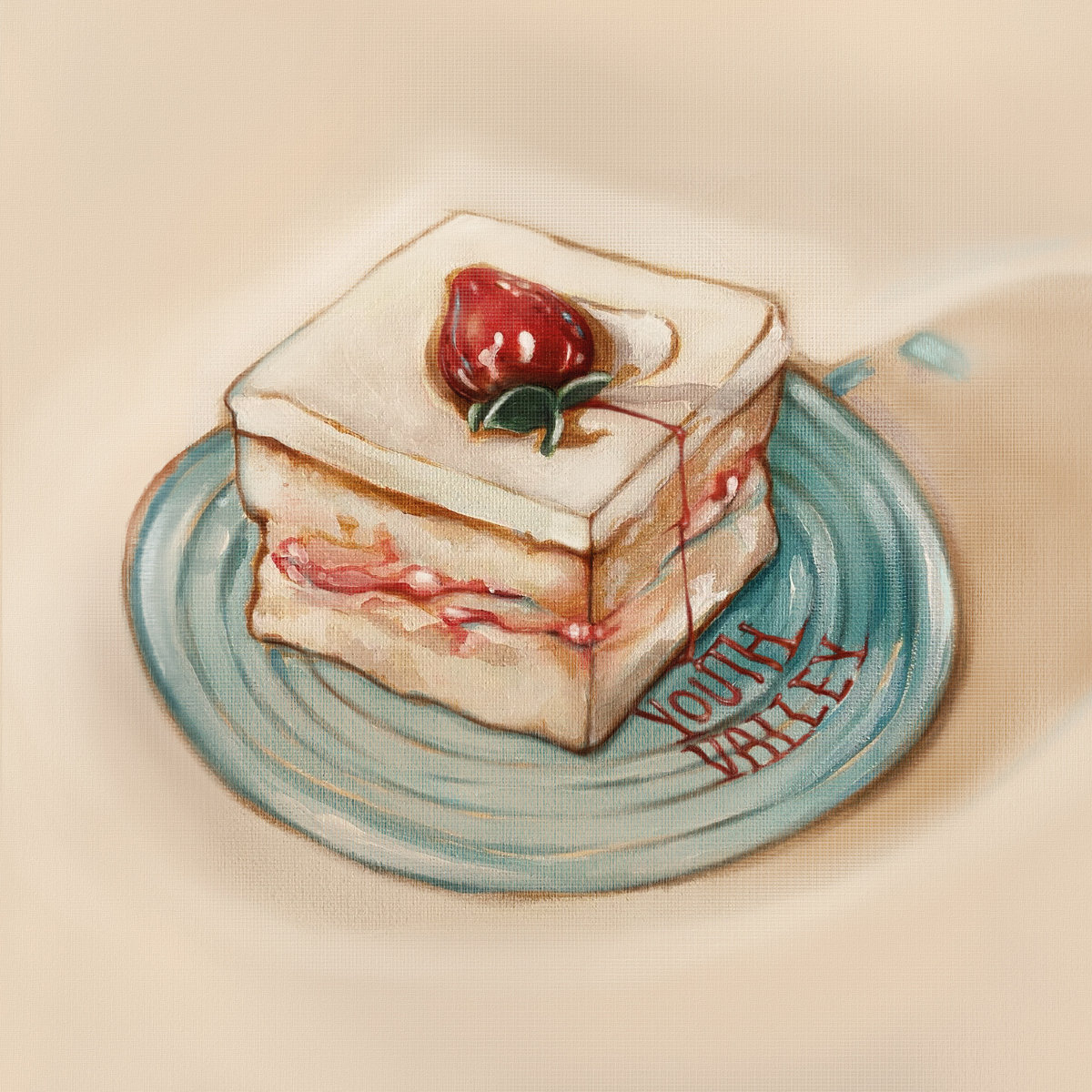
For these recordings, Joseph Powell handles vocals and guitars, accompanied by George V on guitars, Dean Jola on drums and percussion, and Aki Rei on guitars and keyboards. Alex Bolpasis performs bass throughout the album and shares production responsibilities with Powell, having also recorded and mixed the material at Suono Studio. Mastering was completed by Nick Townsend at Infrasonic Sound, while Annja Saudade created the cover artwork.
The production plays an important role in establishing the album's character. Youth Valley's guitars can be expansive without completely overwhelming the arrangements, while the rhythmic foundations preserve enough post-punk urgency to prevent the songs from becoming static. The contrast between brighter melodies and darker lyrical concerns gives the music much of its emotional depth.
There is an obvious connection here with the atmospheric British guitar music of the 1980s, but Youth Valley also belong to a contemporary generation that treats shoegaze and post-punk as complementary languages. The former provides texture, distance and emotional scale, while the latter contributes movement, tension and a more direct sense of confrontation.
What makes As Passive Aggressive As It Gets particularly interesting is the way those elements reflect its subject matter. The music often seems to move forward while the lyrics describe people struggling to escape familiar patterns. Guitars shimmer above feelings of disappointment, and melodies suggest openness even when the words concern an inability to communicate.
Three years after Lullabies For Adults, Youth Valley sound increasingly confident in their ability to connect those contradictions. Their second album is darker and more emotionally focused, but it does not sacrifice the melodic qualities that made their earlier recordings appealing.
Ultimately, As Passive Aggressive As It Gets is an album about the pressures people carry without necessarily revealing them. Youth Valley transform those unspoken frustrations into a mixture of post-punk urgency, indie-rock melody and shoegaze atmosphere, finding beauty in emotions that are often anything but comfortable.
The band's greatest strength lies in understanding that melancholy does not always require quiet music, just as anger does not always need to be shouted. Sometimes the most revealing emotions are those that remain beneath the surface, waiting for the guitars to become loud enough to express what the words cannot.
© Thusblog