

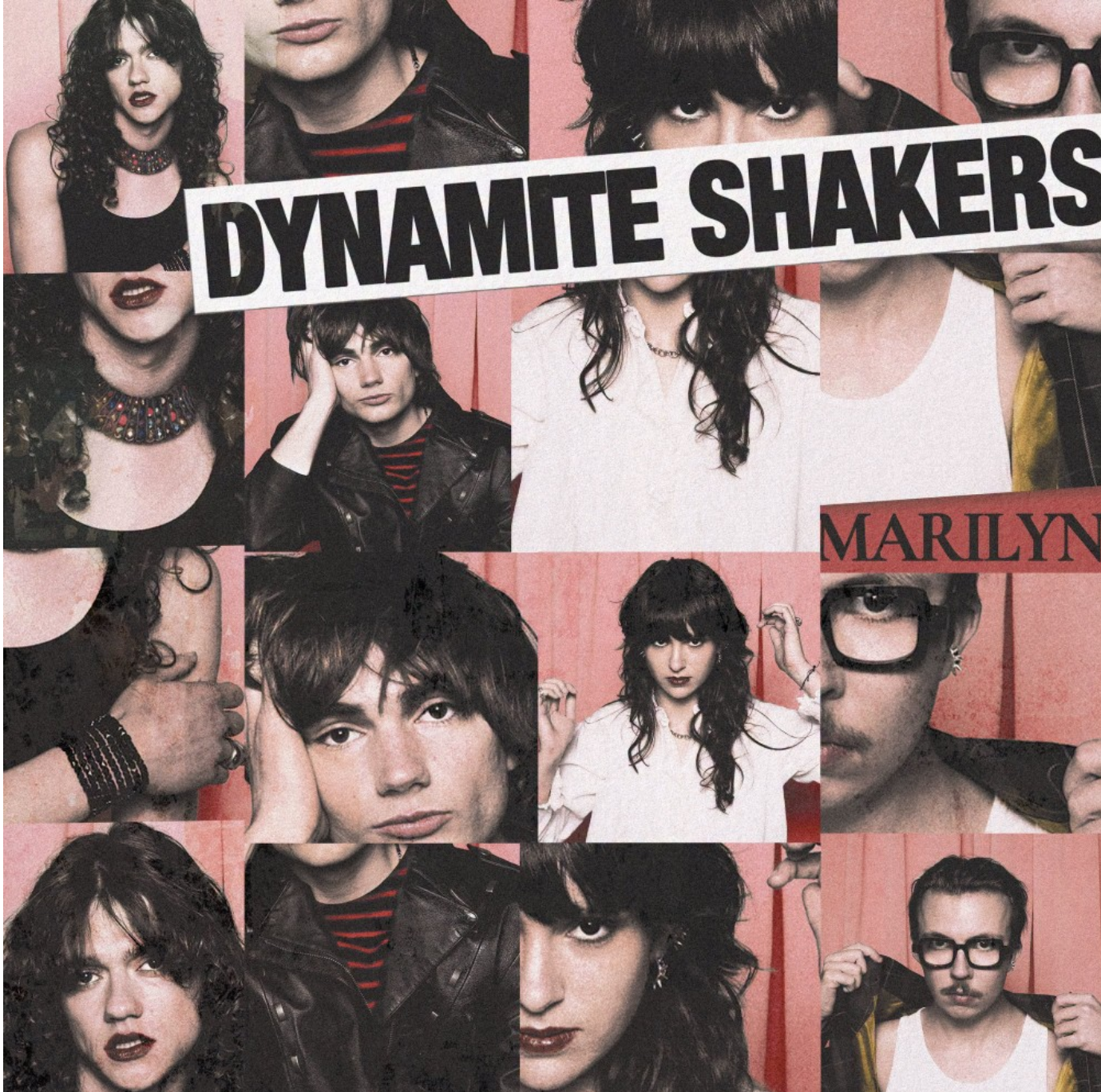
Dynamite Shakers - Marilyn
There comes a point in the development of many young rock bands when energy alone is no longer enough. The first concerts have been played, the first songs have been written, the influences have been absorbed and the initial excitement of simply being a band has already been captured on record. The more difficult question then appears: what happens next?
For Dynamite Shakers, Marilyn sounds very much like an attempt to answer that question.
Released on August 28, 2026 through Barclay, the second album from the Vendée quartet arrives just over two years after their debut, Don’t Be Boring, and finds a group that has lost none of its appetite for immediate, physical rock'n'roll while becoming noticeably less interested in remaining within its original garage-rock framework.
The band of Lila-Rose Attard on bass and vocals, Elouan Davy on guitar and vocals, Calvin Tulet on guitar and François Rocheteau on drums is still remarkably young, but Dynamite Shakers have already accumulated the kind of live experience normally associated with considerably older musicians. Hundreds of concerts, endless clubs and bars and support slots for bands including The Offspring, Sum 41 and Pixies have turned them into a group whose understanding of rock music begins with what happens when four people occupy the same stage.
That background remains audible throughout Marilyn, but the difference is that Dynamite Shakers are now trying to discover how far that energy can travel once it leaves the stage.
An important figure in this transformation is Lionel Limiñana of The Limiñanas, who produced the album, recorded at ICP Studios in Brussels. His involvement makes considerable sense because The Limiñanas have themselves spent years demonstrating how garage rock can absorb psychedelia, pop, repetition and cinematic atmosphere without losing its primitive appeal.
On Marilyn, those possibilities begin opening around Dynamite Shakers.
The garage rock, rhythm and blues and rock'n'roll that formed the foundations of Don’t Be Boring have certainly not disappeared. The guitars remain direct, the rhythm section still plays with the urgency of musicians accustomed to convincing audiences in small rooms, and many of these songs understand that three minutes can be more than enough time to make their point. However, psychedelia, punk, blues and increasingly confident pop melodies now occupy much more space within the arrangements.
The result is not a rejection of the band's first album so much as an expansion of it.
One of the most important changes is also immediately obvious: Dynamite Shakers are singing considerably more in French.
Where Don’t Be Boring remained largely anglophone, Marilyn includes songs such as “Scellé au sol,” “Cinéma,” “6h10,” “Spleen de toi,” “Démarche cisaillée,” “Détours,” “Par le vide” and “Équipage ravage.” English remains part of their vocabulary, but French is no longer an occasional deviation from the group's identity.
This matters because it changes more than the lyrics.
There has always been a slight danger for young European garage bands that their affection for American and British rock history can become so convincing that their own geographical identity almost disappears. Dynamite Shakers clearly love the music that shaped them, but Marilyn begins to place some distance between influence and imitation. Hearing their garage and punk instincts interacting with French lyrics immediately gives the songs a different rhythm and personality.
It makes Dynamite Shakers sound less like a very good young band interpreting an inherited rock'n'roll language and increasingly like Dynamite Shakers themselves.
The fourteen-track album, running for approximately 44 minutes, has also been conceived with something of the logic of a traditional vinyl record. Its two halves have noticeably different proportions, with the first side favouring compact songs that rarely cross the three-minute mark before the second half begins allowing ideas considerably more room to develop.
Opening track “Scellé au sol” establishes the urgency immediately. It is fast, aggressive and propelled by something approaching punk velocity, making it an effective reminder that whatever experimentation appears later on the record has not weakened the band's fundamental physicality.
“Cinéma” reveals another side of that evolution. With Lila-Rose Attard singing in French, the song leans much more openly towards melodic pop-rock without sacrificing the nervous energy surrounding it. Its immediately memorable chorus demonstrates one of the important developments on Marilyn: Dynamite Shakers no longer seem suspicious of writing something genuinely catchy.
The band can still make noise, but increasingly it knows when melody will do more damage.
“Nightclub”, which appeared earlier in 2026, occupies another point between their past and present. There is something repetitive and abrasive in its construction that retains the primitive drive associated with bands such as The Stooges, but it is organised around a chorus designed to remain in the listener's head. The roughness and accessibility no longer feel like opposing ambitions.
Songs including “6h10” and “Spleen de toi” continue widening the record's emotional and musical vocabulary, while the longer pieces on its second half demonstrate that Dynamite Shakers are increasingly willing to allow atmosphere and repetition to become part of the songwriting rather than simply moving as quickly as possible towards the next chorus.
“Get Lost (On the Other Side)”, stretching towards five minutes, would already have felt unusually expansive beside much of the material on their debut album.
The collaboration with The Limiñanas on “Black Out” makes the psychedelic dimension of Marilyn particularly explicit. Lionel Limiñana's presence throughout the record never transforms Dynamite Shakers into an imitation of his own band, but his production appears to encourage them to think about texture and repetition as seriously as they previously thought about riffs and momentum.
This is an important distinction because Marilyn could easily have become an overly polished second album.
Dynamite Shakers have moved from a strongly DIY environment towards Barclay, recorded in a major Brussels studio and worked with an established producer. On paper, that is exactly the point where a young garage band might find its roughest qualities carefully sanded away.
Fortunately, the opposite seems to have happened.
The production is larger and more detailed, but the group still sounds physical. The additional colours have not replaced the guitars or rhythm section; they have simply created more environments in which those instruments can operate.
That development becomes particularly clear when Marilyn is placed beside Don’t Be Boring.
The 2024 album was still deeply connected to garage rock, rhythm and blues and traditional rock'n'roll, with influences stretching back towards The Sonics, rockabilly and various strands of American garage music. Those roots remain audible on Marilyn, but Dynamite Shakers now treat them as foundations rather than instructions.
Their broader collection of influences, extending from Johnny Thunders and The Sonics to Sonic Youth, Stray Cats, Arctic Monkeys and Bad Nerves, helps explain why this record can move from compact punk songs towards pop melodies and then into more expansive psychedelic territory without completely losing its identity.
What holds everything together is not a particular genre but the way the four musicians play.
Even when Marilyn becomes more sophisticated, Dynamite Shakers retain the sense of a group that learned its craft in front of audiences rather than inside a studio. The rhythm section pushes forward, the guitars interact rather than merely decorate the production, and the songs generally avoid remaining in one place longer than necessary.
The difference is that the band now knows how to slow down when an idea deserves more space.
The circumstances surrounding the album's release also demonstrate how quickly their world has changed. Dynamite Shakers have moved from years of DIY concerts in small venues to signing with Barclay, selling out the Alhambra in May 2026 and appearing at Rock en Seine on August 29, only one day after Marilyn was released. A show at Le Trianon in February 2027 already suggests another step upwards.
That trajectory could easily become the main story surrounding the band, but Marilyn is more interesting because it does not simply sound like a bigger-budget version of what Dynamite Shakers were already doing.
It sounds like a group reconsidering its possibilities.
The increased presence of French is particularly important in that respect because it gives Dynamite Shakers a route towards something more personal. The garage and rock'n'roll influences remain international, but the language begins anchoring those influences somewhere more specific. At the same time, Lionel Limiñana's production encourages psychedelic and pop elements to enter without turning the album into a deliberate exercise in retro French rock.
This is why Marilyn ultimately feels like an album of transition and affirmation at the same time.
Dynamite Shakers have not abandoned the urgency responsible for their early appeal. They still sound capable of making considerably more noise than four people should reasonably require, and their years of touring remain embedded in the directness of the performances. What has changed is their willingness to imagine that this energy can support something broader.
The French lyrics, stronger melodies, psychedelic passages, longer arrangements and more ambitious production all suggest a band beginning to understand that growing beyond garage rock does not require leaving its spirit behind.
Don’t Be Boring demonstrated that Dynamite Shakers could play rock'n'roll with conviction. Marilyn asks the considerably more interesting question of what kind of rock band they actually want to become.
There is no definitive answer yet, and that may be precisely what makes the album exciting. Dynamite Shakers are still moving between garage, punk, pop, blues and psychedelia, testing which elements belong together and discovering which doors lead somewhere unexpected.
For a group that built its reputation through the immediacy of live performance, Marilyn succeeds because it retains the electricity of a crowded club while finally beginning to think with the scale and ambition of an album.
© Thusblog
Listen on Qobuz (Hi-res 24 bit)