
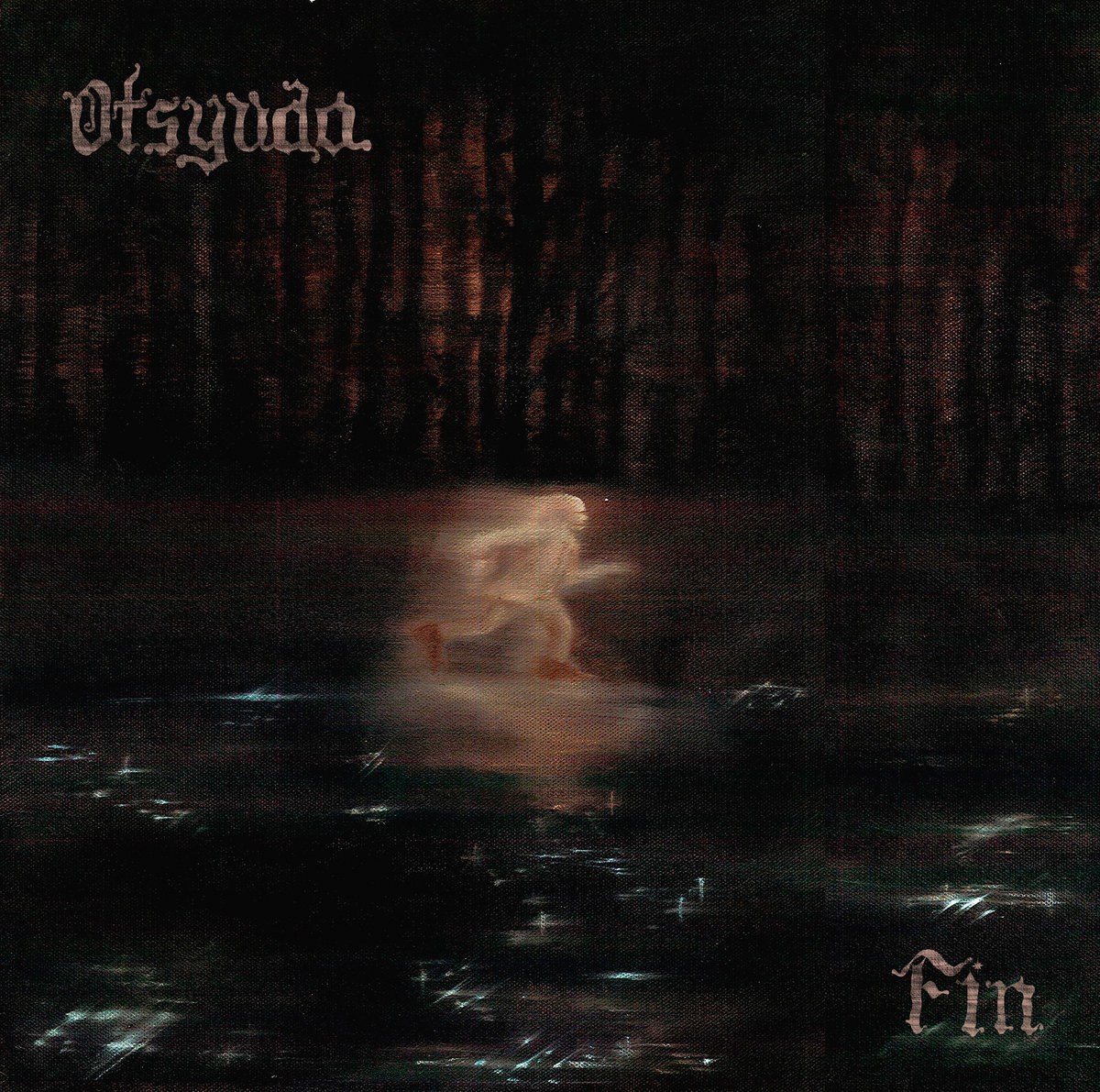
Otsyuda - Fin
The current shoegaze revival has become sufficiently large that simply surrounding a distant voice with heavily distorted guitars is no longer enough to make a band particularly distinctive. One of the more interesting qualities of Otsyuda is that the Toronto-based quintet appears to understand this perfectly. Their music certainly contains the enormous guitars, submerged vocals and dense layers of effects associated with contemporary shoegaze, but these elements are rarely treated as ends in themselves. Instead, Otsyuda use them to create tension, constantly moving between delicacy and physical weight until the point where one threatens to overwhelm the other.
Released on August 28, 2026, their debut album Fin places the group somewhere between shoegaze, grungegaze, nugaze and alternative rock, although the distinctions between those genres quickly become less important than the way Otsyuda moves between them. There is an unmistakable dreaminess to parts of the record, but it exists alongside a rhythm section with considerable physical presence and guitars that are perfectly capable of abandoning atmosphere for the blunt force of a riff.
Otsyuda's story is also particularly connected to Toronto itself. The group's members have roots in Russia, Colombia, India and China, while their name translates approximately as “from here” in Russian. That phrase acquires an interesting significance in the context of a band created by people whose personal histories begin in very different places. The “here” in Otsyuda does not necessarily describe where each member came from, but rather the place where those separate histories eventually converged.
There is something particularly appropriate about that idea for a band whose music is itself constructed from different musical territories. Otsyuda do not sound specifically Russian, Canadian, British or American, even though elements connected to all of those musical histories can be found somewhere within their sound. Instead, Fin feels like the product of musicians who have inherited several decades of alternative rock and are comfortable allowing those influences to occupy the same space.
One important connection with contemporary shoegaze comes through guitarist Daian Aiziatov, formerly a member of Blankenberge, the Saint Petersburg group that has become an important name within Russian shoegaze. That background naturally provides some context for Otsyuda's enormous guitar textures, but the new band quickly developed a noticeably different physical character.
Their first single, “drift,” released in May 2024, already demonstrated this approach. Crystal-clear guitars gradually accumulated tension before giving way to a much more chaotic chorus, after which the song contracted and began rebuilding itself again. That movement between restraint and release would become increasingly important to Otsyuda's identity. The group was never simply interested in maintaining a continuous wall of sound because the transition into that wall was often more exciting than the wall itself.
The January 2025 single “resin” pushed the heavier side of the band further forward. A delicate vocal presence was surrounded by increasingly visceral guitars, allowing shoegaze's softness to collide with something closer to grunge and heavy alternative rock. This is where the term grungegaze becomes particularly useful in describing Otsyuda. The guitars can blur into enormous clouds of distortion, but beneath that haze the bass, drums and riffs remain clearly defined.
There is always an underlying structure.
That distinction becomes essential throughout Fin. Plenty of contemporary bands have discovered the effectiveness of placing ethereal vocals over extremely heavy guitars, and that combination has become one of the defining characteristics of the current nugaze and grungegaze movement. Otsyuda are more interesting when they concentrate on the distance separating those two extremes. Their songs expand and contract, sometimes allowing a relatively clean guitar or vulnerable vocal to exist for long enough that the eventual arrival of distortion feels genuinely dramatic.
The result is music in which density itself becomes part of the songwriting.
A section does not necessarily become heavier because another distorted guitar has been added. Sometimes the bass begins occupying more space, the drums become increasingly forceful or an apparently insignificant guitar texture gradually moves towards the foreground. When the full weight eventually arrives, the listener has already experienced the process that created it.
That characteristic also appears to translate particularly well to Otsyuda's live performances. Their appearance at Exclaim!'s Class of 2026 event at Toronto's Baby G in January demonstrated how quickly the band could move between different guitar textures while retaining a remarkably physical bass presence. The vocals frequently seemed partially absorbed by the instruments rather than sitting clearly above them, effectively becoming another texture within the larger arrangement.
It is an approach that makes comparisons with bands such as Nothing, Narrow Head, DIIV and Hum understandable, although none provides a complete description of what Otsyuda are doing. The connection with Blankenberge can occasionally be heard in the width of the guitars and in melodies emerging from within distortion, but Otsyuda generally possess a stronger attraction towards the weight of grunge and alternative rock.
This gives Fin a solidity that prevents its dreamier passages from simply drifting away.
One of the clearest examples of this developing identity is “As Above, So Below,” released shortly before the album on August 17. The track brings together alternative rock, grungegaze and shoegaze, but even its production history reflects the unusually international character surrounding Otsyuda. It was recorded by Justin McWilliams at Harlow Sound Studios in Toronto, mixed by Luis Felipe Torres in Bogotá and mastered by Mikhail Kurochkin in Saint Petersburg.
Toronto, Bogotá and Saint Petersburg therefore all become part of the same recording, which seems almost accidentally symbolic of the band itself.
The title As Above, So Below also feels particularly appropriate for Otsyuda's music because there is frequently something happening underneath whatever initially attracts the listener's attention. A soft vocal may occupy the surface while guitars slowly accumulate pressure beneath it, while an apparently luminous melody can coexist with a threatening bass line. Conversely, one of the album's heaviest passages can suddenly reveal a surprisingly delicate harmony buried inside the distortion.
The contrast never feels purely decorative because it provides much of the emotional movement within the songs.
This is also why Fin succeeds where some heavy shoegaze records struggle. Volume does not eliminate detail. When every guitar is saturated, every drum enormous and every frequency occupied, shoegaze can easily become an indistinguishable block in which individual songs lose their identities. Otsyuda manage to keep enough separation between the layers for their arrangements to breathe. The guitars can become massive without completely swallowing the rhythm section, while the bass retains enough definition to provide genuine movement underneath them.
The description nugaze consequently makes sense here, not simply because Otsyuda are a young band playing shoegaze in the 2020s, but because their understanding of the genre comes after another three decades of alternative music have already happened. The influence of the original shoegaze generation remains somewhere in the textures, but post-hardcore, emo, slowcore, grunge and heavier forms of alternative rock have subsequently altered what musicians can do with that vocabulary.
For Otsyuda, shoegaze does not need to recreate 1991.
A guitar can disappear into reverb while the bass hits with enormous physical force. A vocal can remain deliberately indistinct while the drums push aggressively forward. A melody can retain the melancholy traditionally associated with shoegaze while the instruments surrounding it become considerably heavier than most of the genre's original architects would ever have imagined.
That mixture has developed remarkably quickly. Otsyuda had only just begun playing live when drift appeared in May 2024. Resin followed in January 2025, and by the beginning of 2026 the group had been selected for Exclaim!'s Class of 2026, placing them among the emerging acts attracting attention within Toronto's increasingly interesting shoegaze and alternative scene. Fin now turns those early singles and live experiments into something approaching a coherent statement of identity.
There is therefore a pleasing irony in calling their debut album Fin.
For a group that appears to be only beginning to establish itself, naming its first full-length record after an ending feels almost deliberately contradictory. Yet the title also suits music that repeatedly approaches boundaries. Otsyuda's songs often reach moments where the existing arrangement can no longer contain the pressure accumulating inside it, forcing something to change. A delicate melody reaches its limit and distortion enters, or an enormous passage suddenly collapses and exposes something fragile underneath.
The endings repeatedly create new beginnings.
What ultimately makes Fin convincing is not simply that Otsyuda can produce impressive walls of guitar. There are now countless bands capable of doing that. The more distinctive quality is their understanding that saturation only becomes meaningful when something worth uncovering exists beneath it.
Underneath the distortion on Fin are delicate melodies, carefully controlled dynamics and a rhythm section that refuses to disappear into the haze. The quieter passages are not merely pauses before the heavy parts, just as the heavier sections are not simply climaxes placed at predictable intervals. Each gives the other its purpose.
That balance places Otsyuda in an interesting position within the contemporary shoegaze revival. The shoegaze provides depth, melancholy and space, while grungegaze introduces weight and a stronger emphasis on riffs. Nugaze, meanwhile, perhaps best describes the freedom with which the group approaches all of these influences, treating the history of shoegaze as a vocabulary available for use rather than a set of rules requiring preservation.
As a result, Fin can be hazy without becoming shapeless and extremely heavy without sacrificing melody. Its textures may occasionally awaken memories of earlier shoegaze, but the record itself does not feel particularly nostalgic.
Otsyuda are not attempting to reinvent a genre that has already undergone several reinventions during the past decade. What they are beginning to discover is something considerably more important for a new band: their own relationship with noise, weight and space.
For an album called Fin, this sounds remarkably like a beginning.
© Thusblog
Listen on Qobuz (Hi-res 24 bit)