

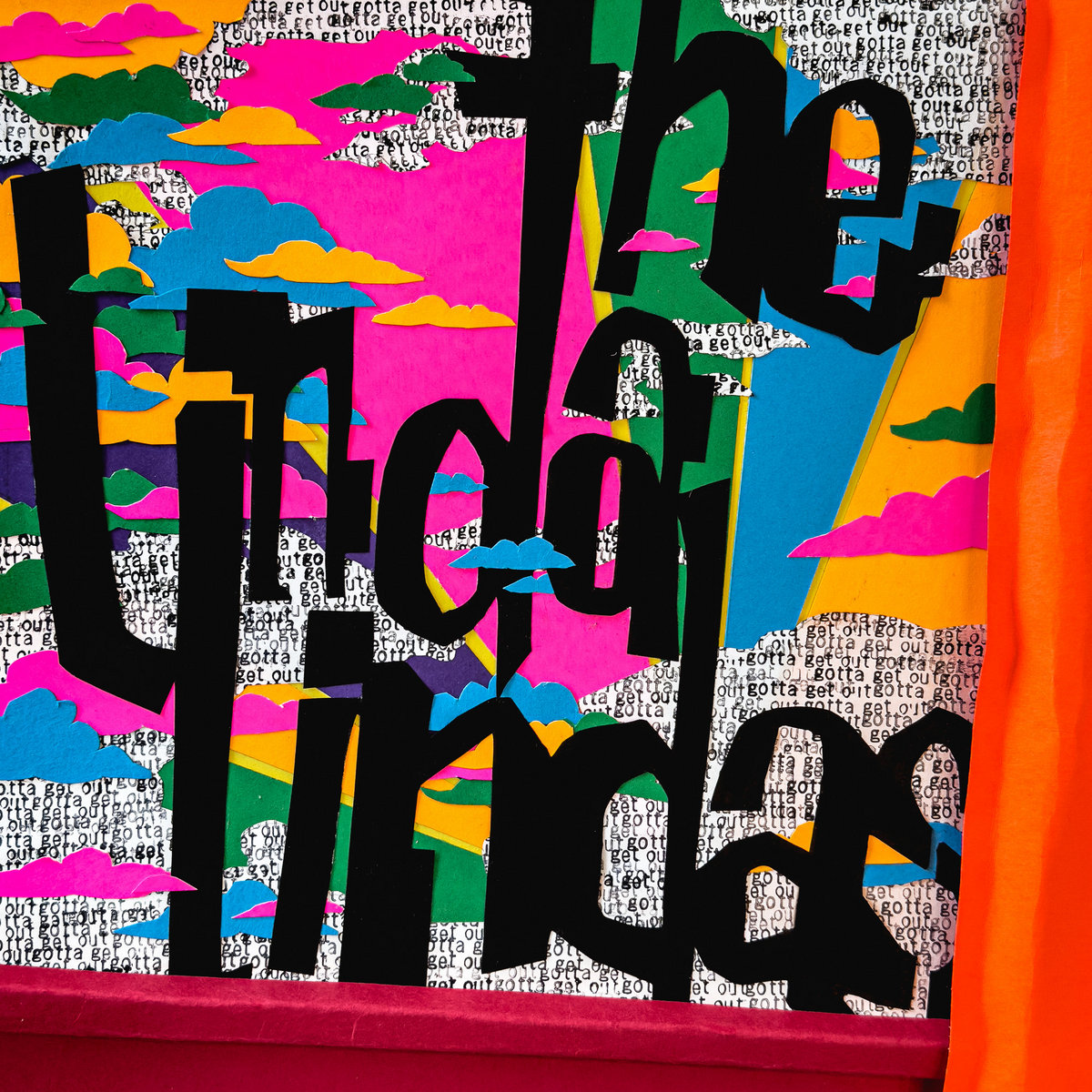
The Linda Lindas - Gotta Get Out
For much of their early career, The Linda Lindas were accompanied by a story that was almost impossible to separate from their music. They were extraordinarily young, they played punk, they emerged from Los Angeles, and their performance of “Racist, Sexist Boy” at the Los Angeles Public Library in 2021 suddenly transformed them from a local band into one of the most visible young voices in American punk.
Five years later, that story is beginning to feel much less important.
With Gotta Get Out, released on August 28, 2026, Bela Salazar, Eloise Wong, Lucia de la Garza and Mila de la Garza have made an album that seems determined to escape almost every convenient description previously attached to them. Punk remains fundamental to their identity, but across twelve songs they move through garage rock, power pop, new wave, hardcore, post-punk and increasingly atmospheric indie rock, sometimes changing direction within the space of only a few minutes.
It feels less like The Linda Lindas abandoning their original sound than discovering how much territory exists beyond it.
That sense of exploration was built into the way the album was created. Instead of arriving with mostly completed individual songs, the four musicians spent time together in Palm Springs, deliberately separating themselves from everyday distractions and developing ideas collectively. Further sessions in Long Beach continued the process, with roughly thirty songs eventually being developed before the final twelve were chosen.
The change in working method matters because Gotta Get Out sounds much more like four musicians experimenting inside the same room. A synthesizer pattern, guitar texture or rhythm can become the foundation of a song without anyone apparently worrying about whether it fits an established Linda Lindas formula.
The title track makes that immediately apparent.
“Gotta Get Out” introduces nervous synthesizers, a shadowy bass line and a distinctly new wave atmosphere before the guitars begin cutting through. There are traces of 1980s alternative music alongside the band's Californian punk instincts, but the song's importance lies less in its influences than in what it announces.
The need to “get out” becomes almost a manifesto for the album itself.
This is music concerned with escaping repetition, expectations and the strange prison that can develop when other people decide what a band is supposed to represent. The Linda Lindas are not escaping punk. They are escaping the possibility that punk might become another set of rules.
That freedom allows Gotta Get Out to move in several directions without asking permission.
“Burning Out” has the immediacy and melodic rush expected from the band, but beneath its energetic surface sits a much less youthful feeling of exhaustion. The music keeps racing while emotionally everything feels stuck. It is one of several moments on the album where growing older is no longer treated simply as the adventure suggested by Growing Up four years earlier.
“Helado de Limón”, sung in Spanish by Bela Salazar, heads somewhere sunnier. Garage rock and surf-pop energy give the song an almost carefree momentum, yet beneath that brightness lies a familiar Linda Lindas trick: allowing difficult emotions to hide inside music that feels immediately pleasurable.
The song is sweet and acidic at exactly the same time.
Then “Blood On Our Hands” tears through that atmosphere.
Eloise Wong pulls the band towards hardcore, with heavier guitars, aggressive vocals and a physical urgency that feels connected to Los Angeles' contemporary hardcore scene. Its political concerns surrounding responsibility, militarisation and authoritarianism also demonstrate that The Linda Lindas have lost none of the anger that originally made people notice them.
Later, the 83-second “Break” compresses that instinct into an even smaller space. It arrives, explodes and disappears before there is much opportunity to recover.
The difference is that these moments no longer define the entire record.
At the other end of the spectrum is “Closer,” featuring Hayley Williams of Paramore, where the band's power-pop and emo instincts expand into something much larger. Layered vocals and thick guitars create an almost overwhelming density, while the lyrics introduce one of the album's recurring anxieties: time is moving, childhood is disappearing and there is no way of slowing any of it down.
It would have been easy for Williams' appearance to become the centre of attention, but the collaboration feels surprisingly integrated into the song. Rather than sounding like The Linda Lindas featuring a famous guest, it sounds like another stage in the band's increasingly ambitious approach to arrangement.
“Nothing Left” pushes further into new wave and post-punk. Its bass and guitar textures carry distant echoes of Blondie and Siouxsie And The Banshees, but the song retains the bright melodic instinct that has always prevented The Linda Lindas from becoming excessively severe.
The contradiction is particularly effective because the subject is environmental destruction and economic greed. One of the catchiest songs on the album is also one of its bleakest.
The Linda Lindas have always understood that political music does not have to sound like a lecture. Anger can be danced to.
“High Horse” changes the proportions again, bringing distorted and acoustic guitars together around a heavier groove and a sarcastic lyric aimed at self-importance. There is something of 1990s alternative rock in its weight, but the hooks remain pure power pop.
That melodic instinct is one of the threads holding Gotta Get Out together.
No matter how far the arrangements wander, The Linda Lindas rarely lose sight of the song underneath them.
This becomes especially clear on “I Could Be Wrong,” where the new wave influence is allowed into the sunlight. Bright guitars, precise rhythms and an immediately accessible melody recall the nervous pop energy of bands such as The Cars and Blondie. Rather than hiding their pop instincts beneath distortion, The Linda Lindas increasingly seem comfortable making them part of the foreground.
But the album's most revealing moment may be “Everybody Told Me.”
At 4 minutes and 40 seconds, it is the longest song the group have recorded, and its scale is not achieved through speed. Instead, synthesizers, reverberating guitars and deep bass create a slow, nocturnal atmosphere carrying a clear trace of The Cure.
It is one of the furthest points The Linda Lindas have travelled from the music with which they originally became known.
And strangely, it still sounds completely natural.
That may be the most important discovery on Gotta Get Out. Intensity does not always require faster drums or louder guitars. Sometimes it can come from atmosphere, repetition and the space surrounding a melody.
After the short punk rush of “Okay”, the album makes another unexpected decision with its closing track, “See You Next Time.”
Instead of finishing with an explosion, The Linda Lindas allow the record to drift away through acoustic guitars and dreamy indie-pop textures. There is an almost late-summer melancholy to the song, a feeling of something ending without necessarily disappearing.
It is a beautiful way to close an album so concerned with movement.
Gotta Get Out spends much of its running time opening doors, but See You Next Time doesn't slam the final one behind it.
It leaves it open.
Producer Carlos de la Garza helps give these experiments considerably more space than on the band's earliest recordings. Synthesizers are more prominent, vocal arrangements are denser and guitars can become enormous when necessary, yet the production retains enough imperfections to prevent the record from becoming excessively polished.
That balance is essential because Gotta Get Out is not a perfectly tidy album.
In fact, its restlessness occasionally works against it. Garage rock, hardcore, new wave, post-punk, emo, surf music, indie rock and power pop can arrive in such rapid succession that the album sometimes feels more like an exceptionally good mixtape than a completely unified statement.
But perhaps complete unity would defeat the purpose.
The Linda Lindas are currently discovering what happens when the boundaries around their music are removed. Some experiments inevitably fit more comfortably than others, but hearing those discoveries taking place is considerably more exciting than receiving a polished third album designed simply to reproduce what worked before.
Their previous records documented young musicians learning how to become a band.
Gotta Get Out documents the moment they realise they can become almost any kind of band they want.
The punk energy remains essential. The garage-rock immediacy remains. The political anger remains. But there is now room for new wave, power pop, hardcore, dreamier indie textures and songs where atmosphere carries as much emotional force as distortion.
Most importantly, The Linda Lindas no longer need their age to make their story interesting.
They have reached the point where the music can carry that weight by itself.
The title therefore feels particularly appropriate. They needed to get out: out of the expectations surrounding their youth, out of the comfortable pop-punk framework, and out of the assumption that remaining credible requires remaining exactly where they started.
What they find outside is considerably less organised, occasionally chaotic and far more exciting.
Gotta Get Out is not the sound of The Linda Lindas arriving at a final destination. It is the sound of them discovering that there was never any reason to choose only one.
© Thusblog