
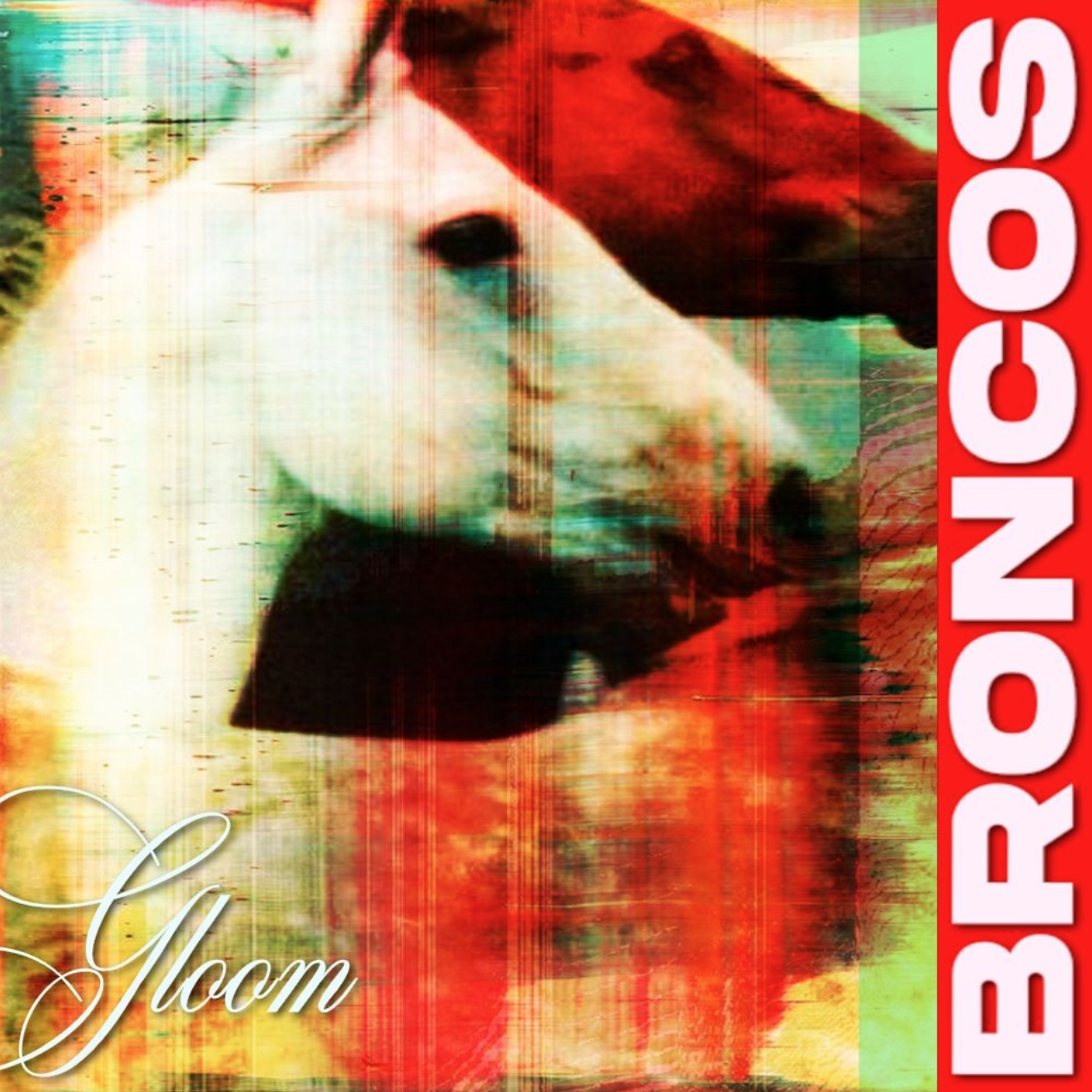
Broncos - Gloom
Belfast has long had a talent for producing bands capable of turning tension into something physical, and Broncos belong to a new generation carrying that instinct into melodic post-hardcore. The trio of Michael Smyth on drums, Cameron Leggat on guitar and backing vocals, and Shane McMullan on bass and lead vocals draws heavily from the restless energy of late-1990s and early-2000s alternative music, but there is increasingly more happening in their songs than simple post-hardcore revivalism.
Broncos came together after several previous musical projects had run their course, with the arrival of McMullan alongside Smyth and Leggat effectively completing the group. From the beginning, there has been a strong DIY mentality behind the band. Rather than separating songwriting, recording and performance into different worlds, Broncos have kept much of that process close to home and closely connected to Belfast's independent scene.
Their first single, “Erode,” released in September 2024, introduced a band built around urgency. Sharp guitars, an aggressive rhythm section and vocals capable of moving between melody and abrasion immediately established the basic vocabulary from which Broncos would begin expanding.
“Lights Out,” released in January 2025, made that identity considerably clearer. The nervous guitar movement and explosive changes in dynamics brought to mind the angular intensity of At The Drive-In, while the contrast between melodic vocals and heavier passages suggested some of the emotional architecture associated with Alexisonfire and the post-hardcore bands that emerged around the beginning of the millennium.
Their individual influences explain some of that chemistry. Smyth has pointed towards At The Drive-In, Drive Like Jehu, Pretty Girls Make Graves and Botch, while Leggat's reference points include Alexisonfire, AFI and Black Peaks. McMullan, meanwhile, has cited Billy Talent, My Ticket Home and Static Dress. Put those different musical instincts into the same rehearsal room and Broncos begin to make considerably more sense: rhythmic aggression colliding with hooks, dissonance interrupted by melody and songs that always seem to be negotiating between control and collapse.
But Broncos have gradually become more interesting whenever they move beyond those obvious foundations.
The 2025 single “Lover” already demonstrated that development. Synthesizers began creeping into the band's sound, while harsher passages were balanced against increasingly melodic sections. Rather than softening Broncos, those additional textures gave the heavier moments somewhere to come from. Noise becomes considerably more effective when silence, space or melody has been allowed to exist immediately before it.
That idea developed further with “Hold Me” in January 2026. The physical intensity remained, but vulnerability became increasingly important, both lyrically and musically. The contrasting voices of McMullan and Leggat were surrounded by delays and synthesizer textures that made the band's world feel larger without sacrificing its essentially raw character.
Their new single “Gloom” feels like the point where those experiments begin to become an essential part of Broncos rather than simply additional decoration.
Instead of immediately throwing everything at the listener, Gloom understands the value of anticipation.
The song emerges through broad, dreamlike synthesizer textures, establishing an atmosphere that feels unusually spacious for a band capable of making this much noise. Guitars gradually begin disturbing that calm, introducing tension before the heavier riffs finally break through.
That progression is crucial to the song.
Broncos could easily have built Gloom entirely around impact. They have the riffs, the rhythm section and the vocal power required to do it. Instead, they make the listener wait. The quieter and more atmospheric sections become part of the heaviness because we gradually begin anticipating what might happen to them.
When the guitars eventually arrive with their full weight, they feel enormous precisely because the song has created somewhere for them to fall.
There is something almost cinematic about the construction. Synthesizers provide distance and atmosphere while the guitars gradually move closer, until the distinction between beauty and threat becomes increasingly difficult to maintain. At its strongest moments, Gloom feels simultaneously delicate and crushing.
The lyrics inhabit exactly the same uncomfortable space.
At the centre of the song is a relationship that appears doomed almost from its beginning. Both the attraction and the warning signs are present, yet knowing how something might end does not necessarily prevent someone from entering it.
That makes Gloom more interesting than a straightforward breakup song. The emotional damage does not arrive unexpectedly at the end. It is already visible somewhere in the distance.
There is a particular kind of sadness in knowingly walking towards something temporary. Logic tells you to turn around, but desire keeps moving forward. You recognise the possible consequences and continue anyway because whatever exists in the present moment feels important enough to justify what may eventually follow.
The music turns that contradiction into sound.
The more ethereal textures suggest attraction, intimacy and possibility, while the heavier guitars introduce the weight of what is already waiting underneath. Neither side completely defeats the other. Instead, Broncos allow them to coexist, which is precisely why the song feels emotionally convincing.
There is beauty here, but the beauty comes with consequences.
Gloom also has an important history outside the studio. The song had already become part of Broncos' live repertoire before its release and appeared in their July 4, 2026 performance at Belfast's Ulster Sports Club, alongside Lights Out, Lover, Hold Me, White Dove, Tailspin and Erode. The track has reportedly developed into a particular audience favourite, and it is easy to understand why.
Its gradual construction seems designed for a live environment.
The atmospheric beginning creates anticipation, while the eventual arrival of the heavier sections provides the release. Broncos are effectively using dynamics to control the physical energy of the room rather than maintaining maximum intensity from beginning to end.
That may also explain why Gloom feels significant at this particular moment in the band's development.
Broncos are now moving towards their debut album, King Laugh, with a launch show scheduled at the Belfast Empire Music Hall on September 18, 2026, alongside SAINTS and Alice Sloan. It represents an important transition for a group whose identity has so far been constructed through individual singles and live performances.
What Gloom suggests is that Broncos' future may lie not simply in becoming heavier, but in becoming broader.
The post-hardcore foundation remains unmistakable. Smyth's drumming provides enormous physical momentum, Leggat's guitars can move rapidly from tension to violence, and McMullan's vocals retain the emotional immediacy that has characterised the band from the beginning. But synthesizers, delays and increasingly atmospheric arrangements are opening spaces inside that intensity.
There are even moments where the haze surrounding the guitars begins to brush against the edges of shoegaze and atmospheric alternative rock, although Broncos never remain there long enough to lose their post-hardcore identity.
That distinction is important. The dreamier elements do not turn Broncos into a shoegaze band. Instead, they give the aggression greater emotional depth. The haze exists so that something can eventually tear through it.
After Erode, Lights Out, Lover and Hold Me, the progression towards Gloom feels surprisingly natural. Each release has added something without completely discarding what came before. The riffs remain. The melodic instinct remains. The chaos remains. What has changed is the amount of space Broncos are willing to place around those elements.
And Gloom benefits enormously from that confidence.
There is always a danger when a young post-hardcore band begins introducing atmospheric textures that the results become unnecessarily polished or that the raw energy responsible for making the music exciting disappears beneath layers of production. Broncos seem to understand that atmosphere does not have to mean restraint.
Sometimes atmosphere simply makes the explosion bigger.
That is ultimately what makes “Gloom” such an effective introduction to this next period of Broncos. It captures a band discovering that heaviness is not simply a question of distortion or volume. Waiting can be heavy. Vulnerability can be heavy. Knowing that something beautiful will eventually collapse can carry more weight than another wall of guitars.
Broncos still sound capable of turning a small venue into complete chaos.
With Gloom, however, they have learned how powerful the silence immediately before that chaos can be.
© Thusblog
Listen on Qobuz Hi-res (24-bit)